

SEO pricing is the most searched and also misunderstood topic for businesses in the US and UK in 2026. Backlinko estimates that the average cost for SEO services ranges from $1,000 to $5,000 per month, with enterprise brands frequently exceeding $10,000 monthly based on competition and business goals. Supporting this data, HubSpot states that 61% of marketers prioritise SEO and organic growth. This is a figure that continues to grow as paid media becomes increasingly expensive.
So, what does effective SEO budgeting actually look like in 2026?
In this guide we breakdown real SEO pricing benchmarks. Learn more about how much to spend on SEO depending on company size, and show you how to justify your SEO budget with ROI: all without fake promises, outdated models, or vague advice.
SEO Spending Benchmarks: What US & UK Companies Invest in 2026
| Small organisations | Mid-sized companies | B2B & SaaS companies | Enterprise brands |
| $750–$2,500/month | $2,500–$7,500/month | $5,000–$15,000/month | $15,000–$30,000+/month |
(Source: Backlinko SEO Pricing Report)
Key Takeaways
- SEO pricing in 2026 emphasizes on competition, expertise, and business objectives along with the keywords
- The average cost for SEO services has increased due to AI search, content quality standards, and authority signals
- SEO budgets must align with revenue goals, not vanity metrics
- Low cost SEO services often fail to deliver sustainable ROI
- Measuring SEO ROI is essential for long-term budget approval
SEO Pricing Guide
SEO pricing in 2026 doesn’t follow flat-rate packages or one-size-fits-all retainers. Rather, seo services pricing now indicates depth of work, technical complexity, content quality, and competitive demand.
Backlinko’s industry research shows that hourly SEO rates range between $75 and $200, while monthly retainers dominate because SEO is a compounding channel.
Additionally, search engine optimisation costs have increased because of AI-powered SERPs, stricter content quality standards, and higher expectations for topical authority. As a result, businesses now pay for strategy, not just execution.
Why SEO Budgeting Matters More in 2026
First, paid media costs continue to rise. WordStream reports that Google Ads CPCs increased by over 19% YoY in competitive industries. Meanwhile, organic search still gets you over 62% of all website traffic.
Second, Google’s AI-driven search experiences reward brands with depth, credibility, and consistency. Thin SEO budgets simply cannot compete in these environments. If your SEO budget does not support expert content, technical optimization, and authority building, rankings fade quickly.
Finally, SEO now impacts every stage of the buyer journey. From discovery to comparison to decision, organic visibility influences trust. That makes SEO budgeting a revenue decision—not a marketing expense.
SEO Budget Benchmarks for Companies (US & UK)
Understanding benchmarks helps businesses avoid underinvestment. According to Backlinko:
- The average cost for SEO services is $1,000–$5,000/month
- SEO campaigns under $500/month rarely succeed
- Companies spending $5,000+/month report higher satisfaction and ROI
In the UK, pricing trends remain similar, though agencies often price slightly lower than their US counterparts due to market dynamics. However, quality SEO optimization price differences are narrowing as global competition increases.
In simple terms, cheap SEO rarely scales, while strategic SEO compounds.
How Do You Calculate the Right SEO Budget
You can begin with revenue goals. If your objective is to generate a $500,000 annually, your SEO budget must support that target.
A practical formula many growth teams use:
Target SEO Revenue ÷ 10 = Annual SEO Investment
For example, if your goal is $1M in organic-driven revenue, a $100K annual SEO budget is reasonable. This aligns with data from HubSpot showing that companies investing consistently in SEO achieve 3–5x ROI over time.
Also consider your industry’s competitiveness. Finance, SaaS, and healthcare require higher seo services costs due to authority requirements and SERP density.
What an SEO Budget Should Include
A realistic SEO budget covers far more than keywords and backlinks.
First, it includes technical SEO, such as site speed, crawlability, structured data, and Core Web Vitals. These foundational elements directly influence rankings and conversions.
Second, it funds content strategy and execution. High-performing SEO content now requires expert input, original insights, and consistent publishing. This is where many low cost SEO services fall short.
Finally, budgets must account for authority building, analytics, and ongoing optimization. SEO is not a one-time project. It is an operating system for growth.
Planning Your 2026 SEO Budget?
If you want a realistic SEO roadmap built around revenue—not vanity metrics—connect with 6S Marketers. We help US and UK brands design SEO strategies that scale sustainably.
SEO Budget Allocation by Business Size
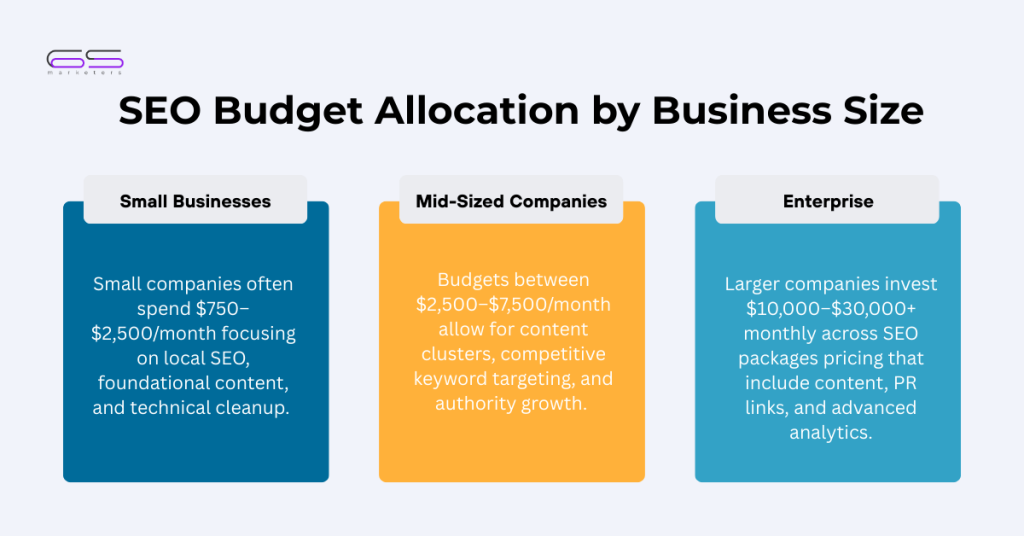
Small Businesses:
Small companies often spend $750–$2,500/month focusing on local SEO, foundational content, and technical cleanup. While results take time, consistent investment beats sporadic spending.
Mid-Sized Companies:
Budgets between $2,500–$7,500/month allow for content clusters, competitive keyword targeting, and authority growth. This is where SEO becomes predictable.
B2B, SaaS & Enterprise:
Larger companies invest $10,000–$30,000+ monthly across SEO packages pricing that include content, PR links, and advanced analytics. These brands treat SEO as a core growth channel.
Measuring SEO ROI for Budget Justification
SEO ROI measurement has matured significantly. Instead of tracking rankings alone, companies now tie SEO to pipeline, revenue, and lifetime value.
As per the Ahrefs, 96.55% of content gets no organic traffic, which proves that quality and strategy matter more than volume. Measuring assisted conversions, organic CAC, and conversion rate lifts helps justify ongoing SEO spend.
When leadership sees SEO lowering acquisition costs over time, budgets stop shrinking—and start compounding.
Conclusion
SEO pricing in 2026 reflects a clear fact: you get what you invest in. Businesses that treat SEO as a long-term growth engine outperform those chasing shortcuts.
Whether you’re evaluating seo services pricing, comparing seo packages pricing, or deciding how much to spend on SEO, the winning approach stays the same—align SEO with business outcomes.
At 6S Marketers, we help US and UK companies build revenue-driven SEO strategies rooted in data, credibility, and sustainable growth. If you’re serious about SEO that compounds, connect with our team and plan your 2026 SEO budget with confidence.
External Sources:
Most companies should allocate 7%–12% of revenue to SEO depending on growth goals and competition.
2. Is SEO cheaper than paid advertising?
Yes. While SEO requires upfront investment, it delivers lower long-term acquisition costs than paid media.
3. When do businesses see SEO shows ROI?
Most businesses see measurable ROI within 4–6 months, with compounding gains after 9–12 months.
A