

Every time a business owner asks that same question – ‘why on earth am I still blogging when AI can spit out answers in the blink of an eye?’ Well, it’s a fair point to bring up, I suppose. But the data paints a very different picture. An astonishing 80% of businesses still treat blogging as a core part of their marketing mix, and it just so happens that companies that blag out blog posts on a pretty regular basis are 13 times more likely to see a positive return on their investment than those who don’t bother (we’re talking Hubspot, 2026 here).
This post cuts through the noise. You’ll learn exactly what AI has done to shake up the search scene, why blogging still has a role to play when it’s done right (and let’s be honest, that’s a big if), what definitely outdated tactics to turf out right now, and what the new rules are for writing blogs that actually grow and grab attention. Whether you run a tiny business or are in charge of marketing at a major enterprise, this guide gives you a down-to-earth roadmap to stop worrying about what comes next – and actually start planning for it.
Is Blogging Still Worth It in the AI Ecosystem?
Yes. Blogging is one of the highest-ROI channels in digital marketing. The strategy, however, has fundamentally changed. Generic, high-volume blog content no longer ranks. Strategic, experience-driven, expert content that demonstrates real authority still earns strong organic visibility — even within AI-powered generative search results. Businesses that align their blogs with E-E-A-T principles and adapt to AI search optimization are seeing stronger returns than ever before.
Key Takeaways
• Blogging still drives the highest ROI among owned media channels for B2B brands
• AI Overviews and generative search have changed how content surfaces — not whether quality content gets found.
• Thin, AI-generated content with no human perspective is actively penalised by Google’s quality systems.
• The new blogging rules in 2026 reward clarity, real expertise, and structured content over volume.
• Human authority signals — author bios, first-person experience, original data — are now decisive ranking factors.
• A documented content marketing strategy is the single biggest differentiator between blogs that convert and blogs that stagnate.
Is Blogging Still a Thing? The Data Say Yes
When people ask is blogging still a thing, they usually picture the personal journal-style websites of the early 2000s. That version of blogging is gone. What has replaced it is something far more powerful: a business asset that quietly compounds value over time.
According to the HubSpot State of Marketing Report 2026, blog posts ranked among the top five highest-ROI content formats, with small businesses 23% more likely than average to see meaningful returns from blogging. Website and blog content paired with SEO remains the single top ROI-generating channel among all digital marketing options.
Furthermore, the scale of adoption makes the answer obvious. Six million blog posts are published every single day. Websites with active blogs have 434% more indexed pages than those without one, dramatically expanding their surface area in search results.
Blogging also generates more than three times as many leads as outbound marketing, at 62% less cost. These stats reflect real business outcomes that companies across every industry continue to experience right now, in the middle of the so-called AI revolution.
How AI Has Changed Search — And What It Means for Your Blog
The rise of generative search has genuinely disrupted how blogs get discovered. Google’s AI Overviews now answer many queries directly on the search results page, reducing the number of users who click through to individual blog posts.
Data from Search Engine Land shows that organic click-through rates dropped from 44.2% in March 2024 to 40.3% in March 2025 in the US alone. That is a real shift. Add to this the growth of tools like ChatGPT, Perplexity, and Gemini, all pulling content from across the web to synthesise answers, and you can see why the old model of “publish and wait for traffic” no longer holds up.
Yet here is what those headline numbers miss. AI Overviews and large language models do not create original content — they surface existing content. They cite sources. They pull from authoritative blogs that demonstrate clear expertise.
The blogs winning today are not necessarily the most prolific publishers. They are the clearest and most credible ones. Generative search has raised the floor for content quality, and that is actually good news for businesses willing to invest in genuine expertise. Understanding how AI search and SGE optimization work is now table stakes for any serious content strategy.
How Does Generative Search Affect Blog Traffic?
Generative search reduces direct click-through traffic for informational queries but increases the citation value of authoritative content. Blogs structured with clear headings, concise answers, and demonstrated expertise are more likely to be cited within AI Overviews and referenced by large language models — creating a new form of visibility beyond traditional organic rankings.
Why Blogging Still Works — When You Do It Right
Strategic blogging still works for three reasons that AI cannot replicate: trust, context, and conversion. A blog post from a named expert — someone with verifiable credentials, real experience, and a point of view — carries a level of trust that auto-generated content simply does not. According to industry research, 70% of people prefer learning about a company through articles rather than ads. And 61% of online consumers have purchased after reading a blog recommendation. That behaviour has not changed because AI exists — if anything, it has intensified as users grow more sceptical of generic AI output.
Additionally, blogging gives businesses a platform to own the full customer journey. A well-structured blog connects awareness content at the top of the funnel to decision-stage content closer to purchase. B2B companies that blog generate 67% more leads than those that do not, and 74% of B2B buyers research online before purchasing. That means your blog is often the first serious touchpoint a prospect has with your brand. When your content answers their actual questions — with depth, experience, and clear guidance — you build the kind of trust that no paid ad can manufacture.
Is Your Blog Working as Hard as It Should?
The 6s Marketers team builds content strategies that rank, convert, and compound over time. If your blog is not generating leads, we can show you exactly why — and fix it.
What No Longer Works in Blogging Today
Google’s Helpful Content system and quality evaluator guidelines have made it increasingly expensive to publish low-effort content at scale.
Here is what the data and industry experts consistently flag as dead weight in 2026:
Keyword-stuffed thin articles
Content that hits a keyword density target but offers no genuine insight gets filtered out by quality systems and ignored by readers.
AI-generated posts with no human editing or perspective
Google has clarified that AI content is not automatically penalised, but content lacking a human point of view consistently underperforms on E-E-A-T metrics.
Chasing volume over depth
Publishing 20 shallow posts per month only worked in 2015. Today, long-form content with real research generates nine times more leads than short-form posts (WifiTalents).
Ignoring internal linking
A blog post with no connection to your broader site structure is a dead end. Internal links distribute authority and help search engines understand your topical depth.
Skipping author credentials
Anonymous content performs worse. Named authors with bios and credentials signal trustworthiness to both Google and readers.
Treating a blog as separate from your SEO strategy
Blogging and SEO are no longer separate disciplines. They are the same discipline.
Search engines have gotten much better at evaluating whether content actually helps the person reading it. Tactics designed to game algorithms rather than serve readers are reliably the ones that stop working first. The future of blogging belongs to content that treats the reader as a real person with real needs.
The New Rules of Blogging in 2026
The brands winning with blogging right now are following a fundamentally different playbook. They treat their blog as a living ecosystem rather than a content factory. They publish less often, but with far greater depth and originality.
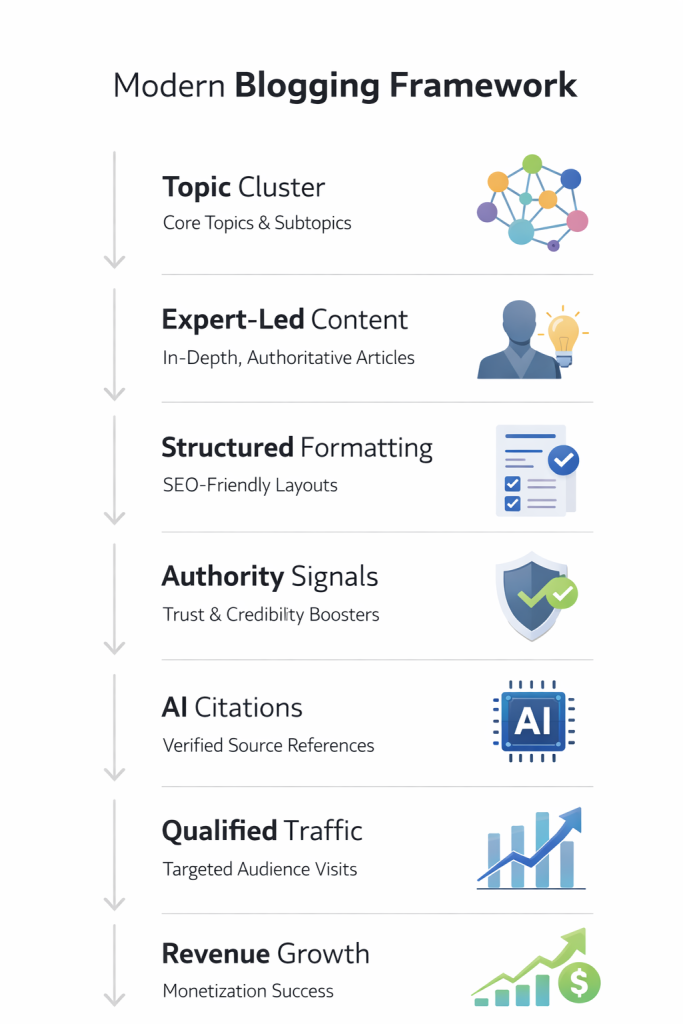
According to the industry report, 86% of marketers plan to increase original research budgets in 2026, with those publishing proprietary data reporting 64% higher conversion rates and 61% stronger organic traffic. Original research — surveys, case studies, unique data — is becoming the single most powerful differentiator in content marketing.
Beyond original research, the new rules centre on clarity and structure. The blogs that survive algorithm updates and AI-driven search disruption are the clearest ones — not the longest, not the most keyword-dense, but the ones where every paragraph earns its place.
Here is what a strong 2026 blogging strategy actually looks like:
- Publish with a named, credentialed author and a detailed author bio.
- Structure every post with clear H2s and H3s that directly answer user questions.
- Lead every article with the most important answer — do not bury it.
- Include original data, first-person experience, or case study evidence.
- Add an ‘updated’ date and refresh high-performing posts regularly.
- Build strong internal linking across your topic clusters.
- Optimise each post for featured snippets and AI Overview citation.
- Measure conversion metrics — not just traffic — to understand true ROI.
AI vs Human Authority — Why Human Expertise Still Wins
There is a meaningful difference between content produced by AI and content produced by a human who happens to use AI as a tool. The first lacks something that both search engines and readers pick up on: lived experience.
Google’s E-E-A-T framework — which now includes Experience as a specific signal — explicitly rewards content that demonstrates first-hand knowledge. A travel blog written by someone who has visited the destination, a legal explainer written by a practising attorney, or a marketing guide written by someone who has managed real campaigns: these carry weight that rephrased AI output simply does not.
This distinction becomes even more pronounced inside generative search. Large language models preferentially cite sources that are established, clearly attributed, and linked to recognisable domains. They build trust hierarchies based on signals like how long a domain has been active, how consistently an author publishes, and how many credible external sites reference that content.
Consequently, the authority your blog builds today directly determines whether your content gets cited in AI answers tomorrow. Human-authored, experience-backed blogging is not competing against AI — it is the content that AI learns to trust and surface.
Blogging ROI Comparison: Low-Quality AI Blogs vs Strategic Authority Blogs
| Factor | Low-Quality AI Blogs | Strategic Authority Blogs |
| Content Depth | Thin, generic, surface-level coverage | In-depth, experience-driven, original insight |
| Author Signals | Anonymous or no author bio | Named expert with credentials and publishing history |
| E-E-A-T Score | Low — fails quality evaluator criteria | High — consistently passes manual and algorithmic checks |
| AI Overview Citability | Rarely cited by generative search | Frequently cited and surfaced in AI Overviews |
| Lead Generation | Low conversion, high bounce rate | Up to 13x higher ROI; 126% more leads for SMBs |
| Long-Term Traffic | Peaks briefly then declines after updates | Compounds over time; evergreen posts drive sustained traffic |
| Google Algorithm Risk | High — vulnerable to core updates | Low — quality signals protect rankings across updates |
| Backlink Acquisition | Rarely earns natural links | Original research earns high-authority inbound links |
| Publishing Frequency | High volume, low value | Consistent cadence focused on quality and topical depth |
| Overall Business Impact | Minimal measurable ROI; often negative brand effect | Drives qualified traffic, leads, and customer trust |
Conclusion
Blogging is not dying. Lazy blogging is dying. The type of business that treats their blog as a proper authority platform – not just a never-ending content production line – is the one seeing increased revenue, stronger lead generation pipelines, and growing organic visibility even as AI starts to change the face of search. The future of blogging belongs to those businesses who are willing to invest in real expertise, do some original research, and write content that serves both real people & the machines that are starting to do the digging for us.
At 6s Marketers, we specialise in building content strategies that drive measurable business outcomes. From technical SEO audits to full-scale authority blogging programs, our team helps businesses turn their blogs into their most valuable lead generation channel. If you are ready to build a content engine that actually works in the AI era, connect with us today and let us show you exactly where to start.
External References
1. HubSpot State of Marketing Report 2026
2. Search Engine Land — Blogging, AI, and the SEO Road Ahead