

Over the last few years, eCommerce brands have witnessed rising ad costs and declining organic click-through rates while AI-powered search results and marketplace features increasingly dominate the first page of search results. Google Ads cost-per-click rose about 13% year-over-year in 2025. This resulted in most industries, including retail and eCommerce, facing higher competition and CPCs as brands spend more on paid search to capture visibility. Unfortunately, many businesses invested heavily in ads while ignoring the long-term benefit of ecommerce SEO.
This blog post addresses that exact challenge. In this article, we look at SEO for ecommerce sites in 2026, what works, and how online stores can build long-term visibility. You will discover realistic and effective strategies, credible insights, and concrete priorities.
Why SEO for eCommerce Sites is Important in 2026
SEO is the backbone of constant and sustainable growth. While ads create instant spikes, ecommerce website SEO builds long-term demand capture across every funnel of the buying journey.
According to a recent study by Statista, global eCommerce sales continue to grow year over year. The study shows that the billions of searches happen before purchase decisions are made. If your store does not appear when users compare, research, or evaluate products, you lose your potential customers to your competitors.
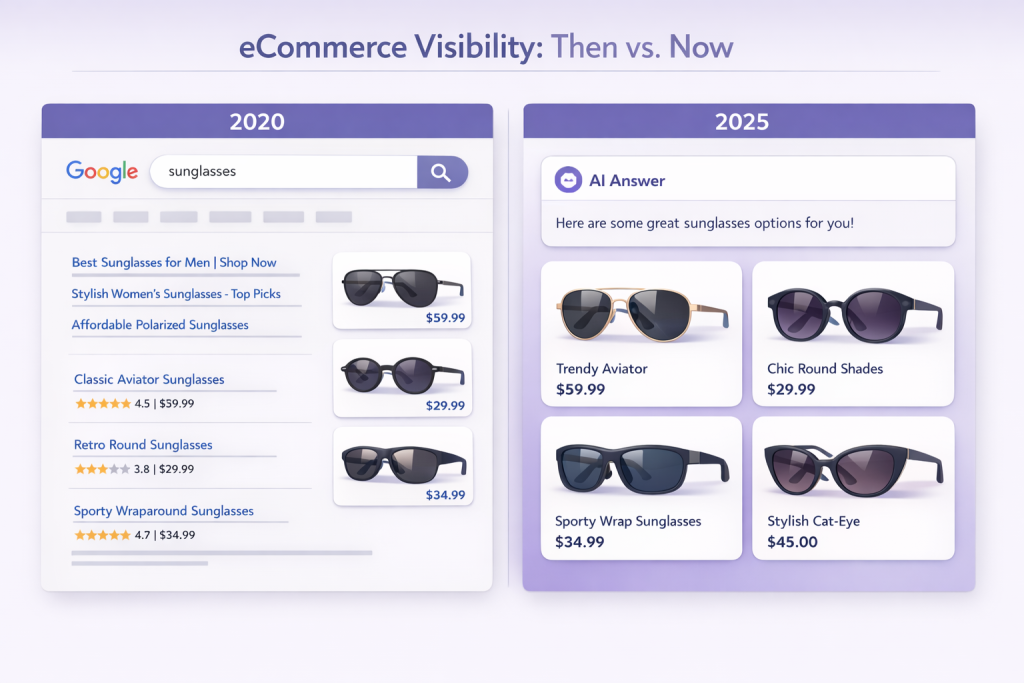
More importantly, search behavior keeps changing and evolving. Buyers now expect fast pages, helpful content, structured data, and real trust signals. Therefore, seo for ecommerce website success in 2026 depends on relevance, experience, and authority. And, there are no shortcuts that will help you grow.
Top eCommerce SEO Trends To Adapt in 2026
The biggest ecommerce seo trends for 2026 focus on experience-first optimization. Google and other search engines are rewarding sites that solve user problems faster and more clearly.
Experts interviewed by Search Engine Journal mention that AI-driven search results, entity-based SEO, and brand authority will matter more than keyword stuffing or thin category pages. Therefore, online stores must set their business objectives beyond rankings and focus on ROI from SEO.
Additionally, community-driven signals are gaining weight. Discussions from SEO professionals on Reddit indicate that forums, reviews, and authentic brand mentions influence the best ecommerce seo outcomes more than isolated backlinks.
Technical SEO Priorities for eCommerce Websites
Strong technical seo for ecommerce remains the foundation. Without it, even the best content will struggle to perform.
First, crawl efficiency matters more than ever. Large eCommerce sites often waste crawl budget on faceted URLs, filters, and duplicate pages. Proper canonicalization, parameter handling, and logical internal linking ensure search engines index the pages that actually convert.
Another thing is that performance is important in eCommerce SEO. You need to optimize your site to improve your technical SEO. This includes your Core Web Vitals, mobile-first indexing, and server response times that impact ranking and trust. Ecommerce websites that have clear architecture or optimized images or structured data help search engines understand your ecommerce site better and faster.
SEO for Product Pages & Category Pages
Product and category pages drive revenue, yet many brands under-optimize them. Effective seo for product pages focuses on clarity, intent matching, and trust.
Each product page should answer real buyer questions—pricing clarity, specifications, benefits, and use cases. Unique descriptions outperform manufacturer copy because they add value instead of duplication. Additionally, optimized headings, schema markup, and internal links strengthen ecommerce seo signals.
Category pages deserve equal attention. Instead of thin listings, high-performing seo for ecommerce website strategies include short explanatory content, buying guides, and filters that enhance usability without harming crawlability.
AI-Driven SEO Recommendations for 2026
AI is changing how SEO decisions are made, but it does not replace strategy. It improvises it.
By 2026, successful ecommerce seo teams use AI to identify content gaps, analyze patterns of user intent, and prioritize optimizations. By employing predictive keyword clustering, automated technical audits, and search intent classification, we help brands work faster without compromising quality.
AI-generated content itself will not rank. Google further emphasizes Experience, Expertise, Authority, and Trust (EEAT). AI should enhance human-led tactics rather than take their place for optimum ecommerce SEO results.
Content Strategy for Online Stores That Convert
Content is no longer just blogs. It is a conversion asset.
High-performing seo for ecommerce sites includes comparison guides, buyer FAQs, use-case articles, and post-purchase education. These assets attract informational searches while nudging users toward products organically.
Moreover, internal linking between content and category pages strengthens topical authority. This approach improves rankings for competitive terms while building trust. According to industry insights, brands investing in structured content ecosystems outperform those relying only on product listings.
If your store depends heavily on ads or struggles with organic growth, now is the time to fix the foundation. Connect with 6S Marketers to get a data-driven SEO strategy built for scale, not short-term wins.
Local & Voice Search Optimisation for eCommerce
Local intent is expanding beyond physical stores. Even national eCommerce brands benefit from local optimization.
Voice search queries are longer, conversational, and intent-rich. Optimizing for FAQs, natural language queries, and structured data helps brands capture this growing segment. Additionally, local landing pages, Google Business profiles, and region-specific content improve visibility for e commerce website seo.
As voice assistants and AI summaries grow, stores that answer questions clearly will dominate zero-click and assisted search experiences.
Backlinks & Digital PR for eCommerce Growth
Backlinks still work with quality as a major aspect, replacing quantity.
Effective ecommerce seo in 2026 focuses on digital PR, partnerships, and authority mentions rather than mass link-building. Editorial links from industry publications, data-led studies, and authentic brand mentions send strong trust signals.
The unlinked brand mentions and community validation increasingly support seo for ecommerce sites, especially when combined with strong on-site signals.
CRO + SEO Integration: Turning Traffic into Revenue
Traffic alone does not grow businesses—conversions do.
Modern best ecommerce seo integrates Conversion Rate Optimization (CRO). SEO brings qualified users, while CRO removes friction. Together, they multiply results.
Clear CTAs, trust badges, fast checkout flows, and persuasive copy improve engagement metrics that indirectly support rankings. When users stay longer on your website and convert more, search engines understand the experience as valuable.
Conclusion
The best eCommerce SEO for online stores in 2026 is more about precision, experience, and credibility. Brands that invest in technical seo for ecommerce, user-focused content, and authority-building will outperform their competitors in acquiring customers and increasing ROI.
If you are looking for an SEO for eCommerce websites expert, connect with 6S Marketers. We offer eCommerce SEO services, helping eCommerce brands build credible and measurable SEO systems that bring qualified traffic, improve conversions, and protect growth from rising ad costs.
FAQs
1. Will ecommerce SEO still be worth investing in 2026?
Yes. Organic search is still one of the highest ROI platforms for online stores.
2. How will eCommerce SEO be different in 2026?
In 2026, eCommerce SEO will primarily focus on search intent, user experience, and AI visibility rather than only rankings. Additionally, structured data, useful content, and trust signals are important search engine ranking factors for displaying products in AI summaries, rich results, and voice search.
3. Why is structured data a need for eCommerce?
Structured data makes your products visible through rich results, shopping features, and AI-generated search results in 2026. It will help search engines and other AI tools precisely understand necessary product details such as price, availability, reviews, and variants.
4. Will AI be Necessary for eCommerce SEO in 2026?
Yes. With AI, the data can be analyzed, it helps to identify content gaps, and the scaling up of the SEO efforts can be ensured. On the other hand, human expertise ensures that accuracy, strategy, and trust are key components of long-term success in eCommerce SEO.