

Enterprise website redesigns often promise better UX, stronger branding, and improved conversions. Yet, many large organisations experience something unexpected after launch: a sharp drop in organic rankings and traffic.
This isn’t bad luck. It’s usually the result of SEO signals being disrupted during the redesign process.
In this guide, you’ll learn why large enterprises lose rankings after a website redesign, what actually breaks under the hood, and how to recover visibility in AI-powered search results like Google AI Overviews (SGE), Bing Copilot, and conversational search.
Why Rankings Drop After a Website Redesign
Large enterprises lose rankings after a website redesign because:
- URLs change without proper redirects
- Technical SEO signals break
- High-performing content is removed or altered
- Internal linking structures collapse
- Page speed or mobile experience worsens
Recovery is possible with a structured enterprise SEO approach focused on technical fixes, content restoration, and signal continuity.
Key Takeaways
- A website redesign can reset years of SEO equity if not managed carefully
- Enterprise SEO failures usually stem from technical and structural changes, not design alone
- Rankings can recover within 3–6 months with the right SEO-led recovery plan
- AI-powered search rewards clarity, consistency, and preserved authority
- SEO must lead redesign decisions—not follow them
What Is a Website Redesign (From an SEO Perspective)?
A website redesign is beyond a visual update. From an SEO standpoint, it involves changes to:
- URLs and site architecture
- Content structure and relevance
- Internal linking and navigation
- Page templates and rendering
- Performance, mobile usability, and crawlability
For large enterprises, these changes affect thousands of indexed pages, making SEO risk significantly higher than for small sites.
Search engines and AI-driven search systems reassess your site almost entirely after a redesign.
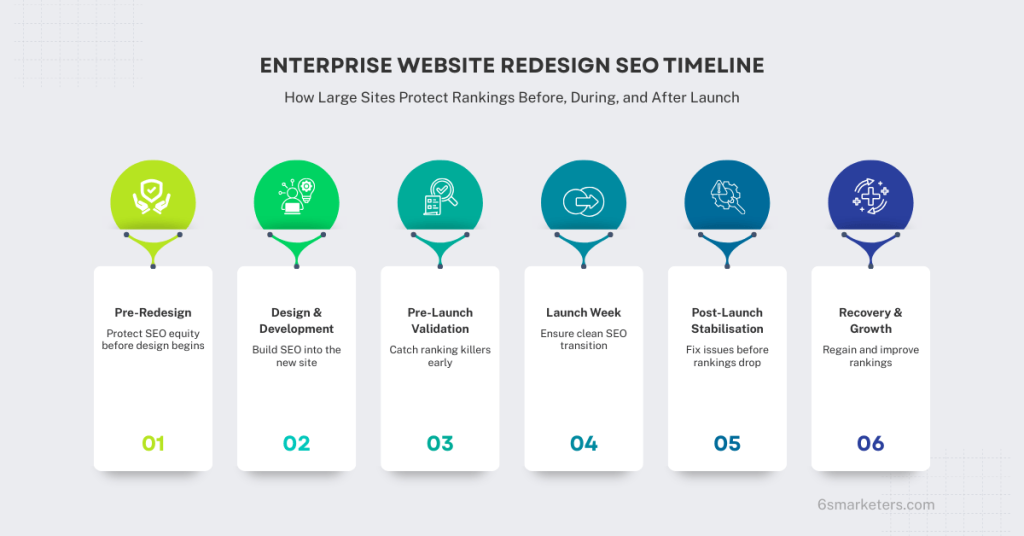
Why Website Redesigns Are Risky for Enterprise SEO
Enterprise websites accumulate authority over time. Backlinks, rankings, crawl patterns, and user signals are built page by page.
A redesign disrupts these signals all at once.
When Google or Bing re-crawls a redesigned enterprise site, they often treat large sections as new, especially if:
- URLs change
- Internal links are removed
- Content intent shifts
- Technical signals reset
In AI-powered search, this risk is amplified. AI Overviews rely on stable, trusted sources. Any inconsistency can reduce your visibility in summaries and featured answers.
Common Reasons Enterprises Lose Rankings After Redesigns
Ranking losses are rarely caused by one mistake. They usually come from a combination of issues.
URL Changes Without Proper Redirects
This is the most common failure.
When old URLs are removed or altered without clean 301 redirects, search engines lose:
- Page authority
- Backlink value
- Historical relevance
For enterprise sites, if there is a 5% redirect gap, then it can affect hundreds of revenue-driving pages.
Loss of Search Intent Alignment
Redesigns often rewrite content for brand tone or brevity. Unfortunately, this can remove:
- Keyword relevance
- Long-tail intent coverage
- Problem–solution clarity
AI search prioritises intent match, not design language.
Internal Linking Breakdown
Navigation and footer links often change during redesigns. When internal links disappear:
- Authority stops flowing to key pages
- Crawlers struggle to discover deeper URLs
- Topical clusters weaken
This is especially damaging for enterprise SEO, where internal links act as ranking multipliers.
Technical SEO Issues Introduced During Redesigns
Technical SEO problems are often invisible until rankings drop.
Crawl and Indexing Errors
Common enterprise redesign issues include:
- Noindex tags left from staging
- Robots.txt blocking key directories
- XML sitemaps are not updated
- Canonical tags are pointing incorrectly
Any of these can remove pages from the index entirely.
Page Speed and Core Web Vitals Regression
New designs often introduce:
- Heavy JavaScript frameworks
- Large images and videos
- Third-party scripts
If performance drops, rankings often follow—especially on mobile, where AI search heavily evaluates user experience.
Rendering and JavaScript Issues
Search engines and AI systems still struggle with poorly implemented JavaScript.
If content doesn’t render clearly:
- It won’t rank
- It won’t be summarised
- It won’t appear in AI answers
Content and Internal Linking Mistakes That Hurt Rankings
Content losses are harder to detect—but equally damaging.
Deleting High-Performing Pages
During redesigns, teams often remove:
- “Outdated” blog posts
- Old landing pages
- Long-form guides
If those pages earned backlinks or rankings, deleting them erases authority.
Changing Headings and Structure
AI-powered search relies on a clear structure:
- H1 defines the topic
- H2s define subtopics
- Clean paragraphs explain concepts
Flattened or decorative headings reduce extractability for AI summaries.
Losing Contextual Internal Links
Contextual links inside content help AI systems understand:
- Topic relationships
- Expertise depth
- Content hierarchy
Removing them weakens topical authority.
Redesign Mistakes vs SEO Impact
| Redesign Mistake | SEO Impact |
| URL changes without 301 redirects | Loss of rankings and backlinks |
| Technical audit skipped | Indexing and crawl failures |
| Content removed or shortened | Lost intent coverage |
| Internal links removed | Authority dilution |
| Performance regression | Lower rankings and AI visibility |
| Mobile UX issues | Reduced trust and engagement |
How to Recover Rankings After a Website Redesign
Recovery is possible, but only with an SEO-first approach.
Step 1: Benchmark Pre-Redesign Performance
Compare:
- Top-ranking URLs
- Organic traffic by page
- Keyword positions
- Indexed URLs
This establishes what must be restored.
Step 2: Fix Redirects Completely
Every old URL should redirect to:
- The closest matching new page
- With a single 301 redirect
- No chains or loops
This is non-negotiable for enterprise SEO recovery.
Step 3: Repair Technical SEO Foundations
Audit and correct:
- Indexing rules
- Sitemaps
- Canonicals
- Mobile usability
- Page speed
Search engines need clarity before rankings return.
Step 4: Restore and Improve Content Signals
Rebuild:
- Lost headings and metadata
- High-performing content sections
- Internal links to priority pages
Then enhance content for clarity, not length.
Step 5: Monitor for 3–6 Months
Enterprise SEO recovery is gradual.
- Rankings fluctuate first
- Traffic stabilises next
- Authority returns last
Consistent monitoring is critical.
Website Redesign SEO Checklist (Enterprise-Focused)
Before and after launch, ensure:
- SEO should be involved before design decisions
- URL mapping completed and tested
- Technical SEO audited on staging
- Content inventory preserved
- Internal links validated
- Performance tested on mobile
- Post-launch monitoring in place
This website redesign SEO checklist prevents most ranking losses.
Can a Website Redesign Improve SEO?
Yes, if SEO leads the process.
A redesign can improve:
- Crawl efficiency
- Content clarity
- Internal linking
- User engagement
- AI search visibility
The difference lies in execution.
Conclusion
Large enterprises don’t lose rankings because they redesign.
They lose rankings because SEO is treated as a checklist item instead of a strategy.
In the age of AI-powered search, preserving trust, clarity, and authority matters more than ever.
At 6S Marketers, we specialise in enterprise SEO and website redesign strategy. We help large organisations:
- Redesign without losing rankings
- Recover traffic after failed launches
- Optimise for Google AI Overviews and LLM-driven search
If your enterprise is planning a redesign or recovering from one, connect with our SEO Experts to protect your organic growth.
External Reference:
Website Redesign Avoid SEO Disaster
FAQs
1. Is it normal to lose rankings after a website redesign?
Short-term fluctuations are common. Sustained losses usually indicate SEO issues that need fixing.
2. How long does SEO recovery take after a redesign?
Most enterprise sites recover within 3–6 months, depending on site size and severity of issues.
3. Can redesigns improve SEO if done correctly?
Yes. SEO-led redesigns often result in higher rankings, better engagement, and stronger AI search visibility.