

Google has finally said the quiet part out loud.
John Mueller, Google’s Search Advocate, recently confirmed that free subdomain hosting makes SEO harder, not impossible—but undeniably harder. His statement wasn’t theoretical. It was practical, grounded in how Google evaluates trust, ownership, and long-term site quality at scale.
This matters today more than ever.
As businesses rush to launch quickly using platforms that offer free subdomain hosting (think yourbrand.platform.com), many unknowingly lock themselves into SEO ceilings that are difficult to break later. According to multiple industry studies, over 90% of pages never get organic traffic from Google, and technical foundations play a bigger role than most businesses admit.
This article breaks down what John Mueller actually said, why subdomain SEO behaves differently, and how businesses can make smarter decisions that protect long-term organic growth. If you are evaluating SEO agencies or planning scalable growth, this guide is written for you.
Does Free Subdomain Hosting Hurt SEO?
Yes, free subdomain hosting makes SEO harder—not because Google penalizes it, but because it limits trust signals, authority building, and long-term scalability.
Google can rank subdomains, but free subdomains face structural disadvantages that slow growth, reduce crawl efficiency, and weaken brand credibility.
Key Takeaways (Read This First)
- What John Mueller really meant when he said free subdomain hosting makes SEO harder
- How Google evaluates subdomains vs root domains
- Real SEO challenges businesses face with free subdomains
- When subdomains do make sense (rarely)
- Better SEO-first alternatives for long-term growth
- A practical checklist to decide what’s right for your business
What John Mueller from Google Really Said
John Mueller’s statement came in response to a discussion around why certain sites struggle to gain visibility despite being indexed. He clarified that free subdomain hosting adds friction to SEO efforts, especially for newer or growing businesses.
His point was simple but powerful:
“Google does not penalize free subdomains, yet they often come bundled with shared reputation, limited control, and weaker trust signals.”
The takeaway is not fear—it’s awareness. SEO success depends on ownership, clarity, and consistency. Free subdomains introduce uncertainty across all three.
What Is Free Subdomain Hosting?
Free subdomain hosting allows you to publish a website under a parent platform’s domain, such as:
- yourbusiness.wordpress.com
- yourbrand.wixsite.com
- yourstore.shopify.com
At first glance, it feels efficient. You avoid hosting costs, skip DNS setup, and launch fast. However, free subdomain hosting trades short-term convenience for long-term SEO friction.
From an SEO lens, you do not fully own the domain. You borrow space on someone else’s property. That difference impacts how authority compounds, how backlinks consolidate, and how Google interprets brand legitimacy.
For businesses serious about organic growth, this trade-off becomes expensive over time.
Does Google Treat Subdomains Differently?
This is where confusion often starts.
Yes, Google can rank subdomains. John Mueller has repeatedly stated that subdomains are treated as separate entities in many cases. That flexibility helps large platforms like support.google.com or blog.hubspot.com.
However, separation cuts both ways.
When you use free subdomain hosting, your site often starts with zero independent authority. Any reputation issues tied to the parent platform—or even neighboring subdomains—can indirectly affect crawl prioritization and trust signals.
So when people ask:
- Can subdomains rank in Google?
Yes. - How do subdomains affect SEO?
They fragment authority unless managed intentionally.
That distinction is critical.
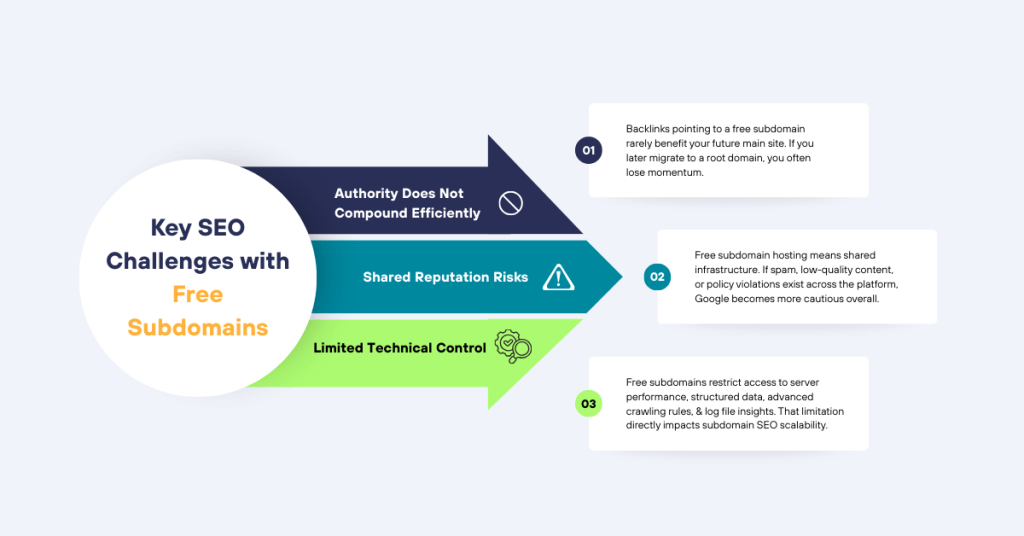
Key SEO Challenges with Free Subdomains
1. Authority Does Not Compound Efficiently
Backlinks pointing to a free subdomain rarely benefit your future main site. If you later migrate to a root domain, you often lose momentum. This is one reason many businesses feel stuck asking, “Do subdomains hurt SEO long-term?”
They don’t hurt instantly—but they slow compounding growth.
2. Shared Reputation Risks
Free subdomain hosting means shared infrastructure. If spam, low-quality content, or policy violations exist across the platform, Google becomes more cautious overall.
This does not mean penalties—but it does mean higher trust thresholds.
3. Limited Technical Control
SEO today depends on:
- Server performance
- Structured data
- Advanced crawling rules
- Log file insights
Free subdomains restrict access to these levers. That limitation directly impacts subdomain SEO scalability.
When Subdomains Make Sense (Rare Cases)
Subdomains are not inherently bad. They work well when:
- The content serves a distinct audience
- The brand already has strong authority
- The subdomain supports functional separation (docs, support, tools)
Enterprise brands use subdomains strategically, not accidentally.
For small and mid-size businesses, however, free subdomain hosting rarely meets these criteria. That’s why the question “Are subdomains bad for SEO?” depends more on execution than structure—but free hosting adds unnecessary risk.
Key SEO Challenges with Free Subdomains
| SEO Factor | Impact on Free Subdomains |
| Domain Authority Ownership | Authority does not fully belong to your business. SEO value compounds slowly because the parent platform retains primary trust signals. |
| Backlink Equity | Backlinks benefit the subdomain, not a future root domain. This makes migrations risky and often leads to traffic loss. |
| Trust & Brand Signals | Google evaluates trust at scale. Free subdomains inherit shared reputation, which raises the bar for ranking consistently. |
| Crawl Priority | Large platforms host millions of subdomains. As a result, Google may crawl your site less frequently, slowing indexation and updates. |
| Technical SEO Control | Limited access to server settings, structured data, log files, and advanced performance optimizations restrict SEO growth. |
| Scalability | SEO growth plateaus faster. As content and competition increase, free subdomain hosting becomes harder to scale sustainably. |
| Migration Complexity | Moving from a free subdomain to a root domain often results in ranking volatility, broken signals, and lost momentum. |
| Perceived Business Credibility | Users and B2B buyers trust branded domains more, which indirectly affects engagement metrics tied to SEO performance. |
Better SEO Alternatives for Businesses
1. Own Your Root Domain
A custom domain builds brand signals, trust, and backlink equity from day one. It allows authority to grow in one direction—up.
2. Use Subfolders, Not Free Subdomains
From an SEO perspective, /blog almost always outperforms blog.domain.com for growing brands.
3. Invest in SEO Infrastructure Early
Hosting, site architecture, and technical SEO decisions made early determine how hard SEO becomes later.
Thinking About Your SEO Foundation?
If your business is currently on free subdomain hosting or planning a migration, this is the right moment to pause and evaluate.
6S Marketers helps businesses fix SEO foundations before growth stalls. From domain strategy to scalable content systems, our approach aligns with how Google actually evaluates sites today.
Talk to 6S Marketers and get clarity before SEO becomes expensive to fix.
Expert Insight from Google (What Businesses Miss)
Google’s guidance consistently points toward clarity, ownership, and long-term value creation. Free subdomains blur ownership. They confuse brand signals. They complicate migrations.
A Reddit TechSEO discussion highlights this struggle clearly, where site owners report indexing without visibility—often tied to structural limitations. Indexing confirms visibility, but competitiveness is earned through stronger SEO foundations.
Practical Decision Checklist
Before choosing free subdomain hosting, ask:
- Will this site need to rank competitively in 12 months?
- Will backlinks and content need to be compounded?
- Will we migrate later?
- Do we need technical SEO flexibility?
If you answer “yes” to even two, free subdomain hosting makes SEO harder than it needs to be.
Conclusion
John Mueller’s statement offered clear direction on how businesses can build SEO that lasts.
Free subdomain hosting makes SEO harder because it limits control, authority, and trust. Businesses serious about organic growth should treat domain decisions as strategic assets, not shortcuts.
At 6S Marketers, we help brands build SEO systems designed for scale—not temporary visibility. If you want SEO that compounds instead of stalls, now is the time to act.
Connect with us and build SEO that actually supports growth.
External Reference:
Free Domain Hosting Makes SEO Harder
A