

Something big has shifted in how people find information online. Google’s AI Overviews now connect with more than 2 billion users every month. ChatGPT serves 800 million users each week. Perplexity processed 780 million queries in a single month, according to Search Engine Land. These aren’t small numbers. They reflect a fundamental change in how search works.
To get featured in AI summary results, structure your content to directly answer specific questions, use clear headers and concise paragraphs, build topical authority, and earn backlinks from credible sources. AI systems prioritize trustworthy, well-organized, and intent-matched content when generating answers.
Key Takeaways
Before we dive in, here’s a snapshot of what you’ll learn in this post:
- What AI summary results actually are and why they matter for your business
- How AI engines decide which content to pull and cite
- The content structure and formatting that increase your chances of being featured
- Technical optimizations that make your site more AI-readable
- Authority and trust signals that build your credibility with AI systems
- A ready-to-use optimization checklist you can apply today
Here’s the uncomfortable truth for most businesses: AI summary results typically cite just 2–7 domains per response, compared to the 10 blue links in traditional search. That means the competition for AI visibility is intense — but so is the reward. If your content earns a citation, you tap into a massive, high-intent audience that trusts the AI’s recommendation. If it doesn’t, you risk becoming invisible to a growing portion of your potential customers.
This guide gives you the exact strategies you need to optimize for AI summaries, AI overviews, and generative search results — so your content shows up where your audience is looking.
What Are AI Summary Results?
AI summary results are the generated, conversational answers that appear at the top of search results on platforms like Google, Bing, ChatGPT, and Perplexity. Instead of showing a list of links, these engines synthesize information from multiple sources and deliver a direct, structured response. The sources they pull from are cited — and that’s where your opportunity lies.
Google calls its version AI Overviews (formerly Search Generative Experience). Perplexity and ChatGPT call their versions AI answer or AI Summary. Regardless of the label, the underlying logic is the same: the AI scans the web, identifies the most credible and relevant content, and weaves it into a coherent answer. Your job is to become one of those credible sources.
Understanding AI summary results also means understanding what they replace. They are rapidly evolving alongside — and in some cases replacing — traditional featured snippets. Researchers at Princeton University introduced the term Generative Engine Optimization (GEO) in late 2023 to describe the practice of optimizing content specifically for these AI-generated answers. Since then, GEO and AI search optimization have become two of the most important disciplines in modern digital marketing.
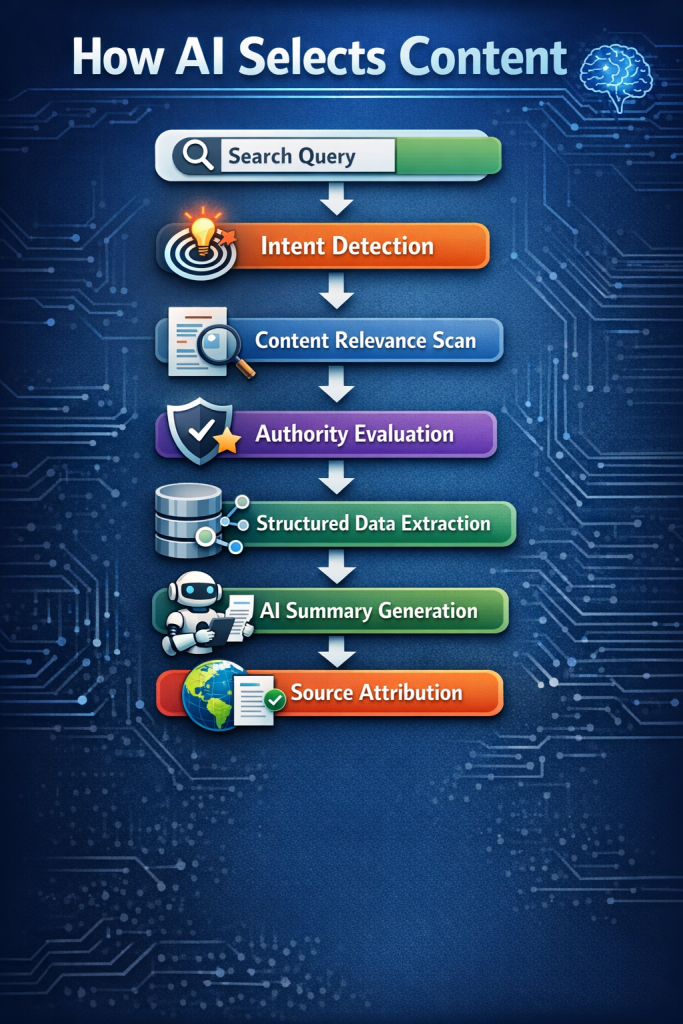
How AI Chooses Content to Feature in Summaries
AI engines don’t pick content randomly. They follow patterns, and once you understand those patterns, you can optimize accordingly. The selection process comes down to a few core factors: relevance, authority, structure, and clarity.
First, AI systems evaluate search intent optimization. They ask: Does this piece of content directly and accurately answer the user’s question? Content that matches the exact intent behind a query — whether informational, navigational, or transactional — gets prioritized. Vague, keyword-stuffed content fails this test every time.
Second, AI evaluates trust signals. Backlinks from authoritative domains, author credentials, citations from verified sources, and consistent brand mentions across the web all tell the AI that your content is reliable. Sites with strong E-E-A-T (Experience, Expertise, Authoritativeness, and Trustworthiness) signals consistently earn more AI citations. AI models cite far fewer domains per response than traditional search, making trust signals even more critical to get right.
Content Structure That Wins AI Summary Placements
The way you format your content matters just as much as what you say. AI systems parse structured content far more efficiently than blocks of dense text. Here’s what consistently works:
- Use clear, question-based headings
AI systems love headings that mirror how people ask questions. Drop the generic “Benefits of SEO.” Use something sharper and audience-focused, like “What Real Advantages Does SEO Bring to Small Businesses?” This directly aligns with how queries are phrased.
- Write concise, direct answers in the first 2–3 sentences after each heading
AI engines often pull the opening sentences of a section when generating summaries. Lead with your core answer, then expand.
- Use numbered lists and bullet points for steps, tips, or comparisons
Lists are easy for AI to parse and reproduce cleanly in summaries.
- Include a clear FAQ section
FAQs are one of the highest-value content elements for AI citations because they directly mirror the question-and-answer format AI systems use.
- Use Shorter paragraphs (3 to 4 sentences max)
Dense paragraphs reduce readability for both humans and AI. Short, punchy paragraphs improve comprehension and AI extractability.
Beyond formatting, topical depth matters enormously. Rather than writing a single surface-level post on a topic, build a content cluster, a pillar page supported by multiple in-depth supporting articles.
AI systems favor websites that demonstrate comprehensive, authoritative coverage of a subject. This approach also supports strong SEO fundamentals that compound your visibility over time.
Technical Optimization That Makes Your Content AI-Readable
Even brilliantly written content can get overlooked if your technical foundation is weak. AI crawlers, like traditional search bots, need clean, accessible, fast-loading websites to do their job effectively. These are the technical factors that most directly impact your AI content optimization efforts:
Page speed and Core Web Vitals
Slow pages get crawled less frequently and are ranked less. Google’s own data consistently shows that page experience signals influence how content is evaluated. Always ensure a Largest Contentful Paint (LCP) under 2.5 seconds.
Schema markup
Structured data (particularly FAQ schema, HowTo schema, and Article schema) directly communicates your content’s purpose and structure to AI systems. While a schema doesn’t guarantee an AI citation, it significantly improves how AI reads and categorizes your content.
Clean URL structure and internal linking
AI systems follow internal links to understand your site’s topical architecture. A logical, clean URL structure combined with intentional internal linking tells the AI what your site is about and which pages are most authoritative.
Mobile optimization
With most searches happening on mobile devices, a poor mobile experience directly reduces your chances of being cited. Responsive design isn’t optional — it’s foundational.
Also, make sure your content is not hidden behind paywalls or login screens. AI crawlers can’t access gated content, which means it simply doesn’t exist in the AI’s world, regardless of how good it is. If you’re concerned about whether your current content strategy aligns with AI guidelines, AI content and Google’s guidelines are worth your time.
Authority & Trust Signals That AI Systems Actually Respect
Trust is the currency of AI summary results. Without it, even perfectly structured content gets passed over. Building authority takes time, but these signals have the most measurable impact on AI citations:
Backlinks from credible, niche-relevant domains remain one of the strongest trust signals. A single link from a respected industry publication carries far more weight than dozens of links from low-authority directories. Focus your link-building efforts on quality over quantity.
Author E-E-A-T signals are increasingly important. AI engines evaluate who wrote the content, not just what the content says. Adding detailed author bios, linking to their professional profiles, and showcasing real credentials (certifications, years of experience, published works) strengthens your content’s perceived authority.
Brand mentions and citations across the web — even without a direct link — contribute to how AI systems perceive your domain’s credibility. Consistent brand visibility on forums, review platforms, and third-party publications builds the kind of ambient authority that AI engines reward.
Original data and research dramatically increase the likelihood of being cited. When your content presents original statistics, case studies, or survey findings, other sites reference you — and AI systems treat those references as strong trust signals. If you can conduct even a small original study, the citation potential is significant.
Getting featured in AI results requires a smart, consistent strategy — and it helps to have experts in your corner. 6s Marketers specializes in AI search optimization and SEO solutions built for today’s search landscape. Whether you’re starting from scratch or looking to strengthen your existing strategy, their team can help you get seen where it matters most. Connect with 6s Marketers today.
AI Summary Optimization Checklist
Use this checklist to audit your content before publishing or during an existing content refresh:
| Optimization Area | Action Item |
| Content Structure | Use question-based H2 and H3 headings |
| Content Structure | Lead each section with a direct 2–3 sentence answer |
| Content Structure | Include at least one FAQ section per post |
| Search Intent | Match content type to query intent (informational, transactional) |
| Search Intent | Use natural language that mirrors how users ask questions |
| Technical SEO | Add FAQ, HowTo, or Article schema markup |
| Technical SEO | Ensure LCP is under 2.5 seconds |
| Technical SEO | Confirm full mobile responsiveness |
| Authority Signals | Add a detailed, credentialed author bio |
| Authority Signals | Earn backlinks from niche-relevant, authoritative domains |
| Authority Signals | Include original data, stats, or research where possible |
| Content Depth | Build content clusters around your core topics |
| Accessibility | Ensure content is not gated or hidden from crawlers |
| Internal Linking | Link to related posts and pillar pages strategically |
Conclusion
The shift toward AI-generated search results isn’t slowing down — it’s accelerating. Businesses that adapt their content strategy now will earn the citation authority that translates into sustained visibility, trust, and traffic. Those who don’t will find themselves progressively absent from the places where their audience is looking.
Getting featured in AI summary results isn’t about gaming an algorithm. It’s about being the most useful, trustworthy, and well-structured answer available. When you commit to that standard consistently, AI systems notice — and they cite you.
If you want expert help building a content and SEO strategy that wins in today’s AI-first search landscape, 6s Marketers is the team to call. We offer specialized AI search and SGE optimization services designed to help businesses like yours show up in AI overviews, featured snippets, and generative results. Don’t wait for your competitors to claim that visibility first. Connect with us today and start building your AI search presence.
External Sources:
Search Engine Land – How to Optimize Content for AI Search Engines