

Competitor keyword analysis gives you exactly which keywords your competitors are ranking for in search engines and which ones of those your website is missing out on. It discloses content gaps, visibility opportunities, and helps you plan an SEO strategy depending on proven demand.
The keyword gap analysis is one of the fastest ways to find out SEO opportunities you didn’t know existed. When you systematically look at what your competitors rank for, and you don’t, guessing work stops. You will start building content that earns traffic on intent.
This guide walks you through everything: what keyword gap analysis is, why it should matter to you, the best tools that are worth using, and a step-by-step process you can apply.
By the end, you will have a clear, actionable framework for closing your keyword gaps and building a content strategy that outperforms the competition.
Key Takeaways
- Competitor keyword analysis tells you what is working for rivals so you can replicate and improve on it.
- Keyword gap analysis helps you with missing, weak, unidentified, and strong keyword opportunities.
- The best tools for competitor keyword analysis are Semrush, Ahrefs, Moz Pro, UberSuggest, SpyFu, and Google Search Console.
- A structured six-step process turns raw competitor data into a prioritized content action plan.
- Search intent adherence is the difference between rankings that bring traffic and rankings that don’t convert.
- Quarterly keyword gap reviews keep your strategy sharp as competitors and algorithms evolve.
What is Keyword Gap Analysis?
Keyword gap analysis – the lowdown on seeing how your website stacks up against your top competitors in the keyword rankings game. The basic idea is to take a hard look at the keywords they rank for that you’re currently missing out on, and find those areas where they’re leaving you in the dust.
This is the foundation of any serious SEO competitor analysis effort. Rather than trying to build a keyword list from scratch and just hoping for the best, you get to use live data from your competitors to see what terms are actually driving traffic – that’s the value of a keyword gap analysis.
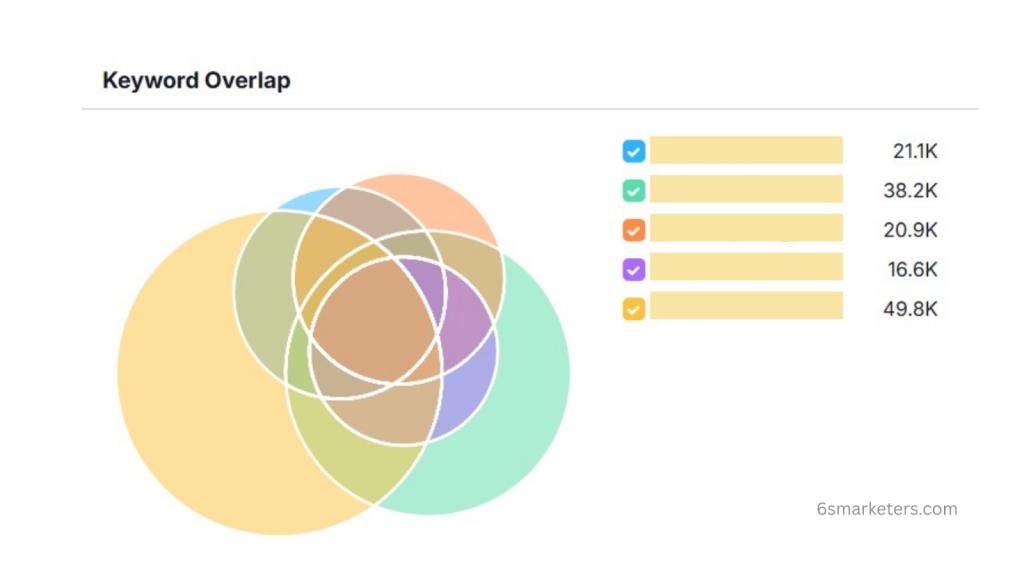
Some people might call this content gap analysis SEO, but rest assured, there is a difference. Keyword gap analysis is all about looking at the actual search terms your competitors are ranking for. Content gap analysis takes a broader view – it’s about seeing where your site is missing out on topics and stages of the customer journey that your competitors are covering.
Both work together as part of a strong dynamic SEO strategy that keeps your site growing consistently.
Why Keyword Gap Analysis Matters for Your SEO Growth
Every keyword your competitor ranks for — and your site does not — represents organic traffic going elsewhere. When a potential customer searches for something you offer and finds your competitor instead, that is a real cost. Keyword gap analysis makes those losses visible so you can act on them.
Beyond traffic volume, keyword gap analysis builds topical authority. When your site has the same keywords as top competitors and then some terms they miss, search engines treat your content as genuine and trustworthy. That kind of authority compounds over time, earning you rankings across clusters of related queries instead of individual pages.
Pairing keyword gap analysis with a full SEO audit checklist offers you both the technical basics and the content roadmap to rank and stay ranked for the terms that matter most to your business.
Four Types of Keyword Gaps You Need to Know
Keyword gaps are not one-size-fits-all. Understanding the different types helps you prioritize which opportunities deliver the fastest results versus which ones require longer-term investment. Let’s explore how to find out what keywords competitors are using and analyse them.
Missing Keywords
You don’t appear in search results for these terms at all. Missing keywords represent the biggest content gaps – topics that you haven’t bothered covering yet. They are often the easiest wins because you simply need to create relevant, high-quality content targeting these terms.
Weak Keywords
You rank for these terms, but your position sits far below your competitors — typically outside the top 10. Your page already has some authority here. Strengthening the content, improving on-page SEO elements, and adding internal links frequently push these rankings into positions that generate real traffic.
Untapped Keywords
These are emerging terms that no one in your space ranks well for yet. Targeting untapped keywords lets you establish early authority before competition builds. The brands that move first on rising search terms often hold those positions for years.
Strong Keywords
These are the keywords where you already outperform your competitors. Identifying your strengths helps you protect those rankings — and points to where additional supporting content or internal links can solidify your position even further.
How to Perform Competitor Keyword Analysis Step-by-Step
Here is a practical guide that you can follow today, whether you are doing this for the first time or refining an existing approach.
- Identify your true SEO competitors. Search Google for your most important keywords and note which sites consistently appear on page one. These are your SEO competitors — and they may differ from your direct business competitors. Tools like Semrush’s Organic Research feature surface these competitors automatically.
- Extract your competitors’ keyword rankings. Include each competitor’s domain in a platform like Semrush’s Keyword Gap feature or Ahrefs’ Site Explorer. Download the keywords they rank for, especially those in positions 1 through 20, along with search volume and keyword difficulty scores.
- Compare and know the gaps. Parallely run a comparison of your domain versus your competitors. Filter for keywords where competitors rank in the top 10, but your site does not appear at all. Those are your highest-priority missing keywords.
- Filter by intent and relevance. A gap keyword is important only if it matches what your audience actually searches for and aligns with what your business offers. Categorize keywords by intent: informational, commercial, navigational, or transactional.
- Audit your existing content. Before creating new pages, check whether you already have content that touches these gap keywords but is underoptimized. Updating existing pages is often three to four times faster than publishing new ones.
- Build your content action plan. Organize gap keywords into a prioritized content calendar. Assign each keyword to either a new page or an existing article that needs improvement. Track rankings monthly to measure progress.
Also, your site’s technical foundation should be strong before targeting new keywords. A strong technical SEO checklist ensures your new content gets crawled, indexed, and ranked — not buried by preventable technical issues.
Best Keyword Gap Analysis and SEO Keyword Research Tools
The right tools make competitor keyword analysis dramatically faster and more accurate. Here are the top options for businesses at every level.
| Tool | Key feature | Best for |
| Semrush | Side-by-side competitor keyword comparison with traffic potential estimates and keyword difficulty scoring | Agencies and large teams needing an all-in-one SEO platform |
| Ahrefs | Deep backlink data combined with keyword gap analysis across up to 10 competing domains simultaneously | SEO professionals who prioritize link-building alongside content gaps |
| Moz Pro | Priority score that blends volume, difficulty, and opportunity to surface the highest-impact missing keywords | Beginners and mid-size businesses looking for guided, actionable insights |
| SpyFu | Historical keyword and PPC data going back years, revealing how competitor strategies have shifted over time | Marketers running paid search campaigns alongside organic SEO |
| Google Search Console | First-party impressions and click data showing queries where your site ranks but isn’t capturing clicks | Site owners who want free, reliable data directly from Google |
| Ubersuggest | Affordable keyword gap reports with suggested content ideas tied directly to missing keyword opportunities | Freelancers, solopreneurs, and small businesses on a tight budget |
| SE Ranking | Flexible white-label reports and a granular gap view across multiple competitors in one dashboard | Boutique SEO agencies that deliver branded reports to clients |
For most businesses, the strongest approach combines Semrush or Ahrefs for competitive intelligence with Google Search Console for real-performance benchmarking. This pairing delivers both the big picture and the granular accuracy you need to prioritize effectively.
How to Turn Keyword Gaps into Real Ranking Opportunities
Finding keyword gaps is only half the work. The other half is building content that actually earns the ranking. Here is how to make that happen consistently.
The first principle is that your content format should match search intent. A keyword like “best SEO tools for small business” requires a comparison article. A keyword like “how does keyword gap analysis work” calls for a tutorial. Getting the format right doubles your chance of ranking — because you are giving searchers exactly what they want.
- Create new content for missing keywords. Write thorough, well-structured articles or landing pages that target terms your competitors rank for, but you don’t. Go deeper, include more examples, and update more recently than competing pages.
- Strengthen existing pages for weak keywords. Find pages where you rank on page two or three. Improve title tags, headers, and internal linking. Add depth and examples. These pages already have authority — they often need less work than you think.
- Build topic clusters around gap themes. Group related gap keywords under one pillar page with several supporting articles covering subtopics. Topic clusters signal deep expertise and help you rank for entire topic areas, not just single pages.
- Use internal linking strategically. Link from your high-authority pages to new or updated content targeting gap keywords. Internal links accelerate indexing and pass ranking authority to pages that need it most.
- Refresh and monitor regularly. Track rankings for gap keywords monthly. Update pages that are not moving. Capitalise on quick wins by building on your MVPs
Businesses that make a habit of doing this every quarter – not just every now and then – tend to see their organic rankings rise a lot faster than those who just build it and forget about it.
Common Mistakes to Avoid in Keyword Gap Analysis
Even seasoned SEOs can end up making the same old mistakes when they go after a competitor’s keywords. Being aware of these common pitfalls upfront can save you a ton of time and effort.
- Targeting keywords without checking intent. Ranking for a keyword is important only if the people searching it are the audience you want. Always verify that the intent behind each gap keyword aligns with what your business offers and the content you can genuinely create.
- Going after the hardest keywords first. High-competition gap keywords can be tempting, but honestly, they’re rarely the right place to start for most websites. It’s usually better to begin with medium-difficulty, lower-competition terms and work your way up. Build up some momentum and authority first, before you go after the really difficult keywords in your niche.
- Publishing thin content to close gaps. Google’s Helpful Content system is actively downgrading shallow stuff. Every page you ever publish targeting a gap keyword needs to have some real substance, actual examples, and a genuine focus on helping the reader.
- Doing the analysis only once. Competitors are always launching new content, going after new keywords, and shifting their strategies often. So an analysis that was spot on six months ago will probably be way off by now – there may be dozens of new opportunities you’d be missing. Make a habit of reviewing it every quarter.
- Ignoring non-direct competitors. Media sites, industry publications, and comparison platforms frequently dominate high-value keywords in your niche. Analyzing these non-direct competitors reveals topic areas your direct rivals have not even touched yet.
Real Example of Keyword Gap Analysis in Action
Suppose you’re the head of a B2B accounting software company and you do a head-to-head with your top rival, FinanceFirst. They’re actually outranking us for the most important keywords – “invoice automation software for small business”, “accounts payable workflow tool”, and “best accounting software 2025”. A quick check of our site reveals we don’t rank for any of those terms.
A keyword gap analysis shows that all three of those keywords are missing from our site. We take a closer look at search intent to see what’s at play, and it turns out all three are comparable solutions that people are searching for right before they make a purchasing decision.
It also shows that more than 1000 people a month are searching for these three keywords, and the competition isn’t too fierce, judging by the keyword difficulty scores. We respond with a decent comparison article targeting the “best accounting software” search term to help even the playing field.
Meanwhile, the features page gets a facelift with better structure and some helpful internal links to help rank for “invoice automation”. And to top it off, you wrote a new guide on accounts payable workflows to satisfy the search demand. After working on optimising our site for 90 days or so, you can finally say you are in the top 20 for all three terms. And by six months, two of those pages have made it into the top five. Now that’s a pretty common outcome.
Conclusion
Competitor keyword analysis is one of the highest-leverage SEO actions available to any business. It removes guesswork by grounding your strategy in real competitive data. It surfaces proven demand you are currently missing. And it gives you a clear, prioritized roadmap for content that earns rankings and drives revenue.
If you want an expert partner to run this process for you — and build a full-service SEO strategy around the findings — 6s Marketers is the team to call. They specialize in competitor-driven SEO, keyword gap analysis, and organic growth strategies for businesses that take search seriously. Connect with 6s Marketers today and start turning your keyword gaps into your next competitive advantage.
Sources
1. Semrush — Keyword Gap Analysis: What It Is and How to Do It: