

Internal linking for SEO is one of the most underestimated SEO practices. It is the basic element for building topical authority. But many fail to scale it strategically. To build a measurable topical authority, you need to structure your website into content clusters where a detailed page links to supporting, long-tail blog posts or articles.
Today, companies compete in a saturated search ecosystem. Authority, relevance, and structure win. In this guide, we tell you exactly how to use internal linking for SEO to build topical authority SEO at scale. If you are looking for SEO agencies or redefining your organic growth strategy, this article gives you a framework that drives measurable results.
Understanding Internal Linking for SEO
Internal linking is the practise of using hyperlinks on your website that help visitors navigate to another page within the same domain.
It helps:
- Search engines discover and index pages faster.
- Distribute ranking power across key pages.
- Build clear SEO content clusters.
- Improve user navigation and engagement.
- Strengthen topical authority SEO.
Key Takeaways
- Internal links and their types.
- Why internal linking for SEO directly impacts rankings.
- How topical authority SEO works.
- A step-by-step internal linking strategy.
- Internal linking best practices for scalable growth.
- Mistakes that weaken your internal link structure.
- How businesses can use expert SEO services for enhanced results.
What Are Internal Links & Types of Internal Links?
Internal links connect one page on your website to another page on the same domain. They build a logical path for both users and search engines. When internal linking is done correctly, they strengthen your website structure and speeds up content discovery.
There are four main types of internal links:
1. Navigational Links
These appear in menus, headers, and footers. They define your primary site architecture and reflect your internal link structure.
2. Contextual Links
These appear within body content. They carry strong SEO value because they provide semantic context. Contextual internal linking for SEO helps Google understand relationships between pages.
3. Breadcrumb Links
These show the page hierarchy. They reinforce structure and improve usability.
4. Footer Links
These link to important pages like services, privacy policies, or category hubs.
Contextual links drive the most impact in SEO content clusters. They signal depth, relevance, and topical coverage. Strong contextual linking builds clarity across your content ecosystem.
Why Internal Linking Is Important for SEO
Search engines depend on links to crawl the web. Google states that links help it discover and understand pages. Without internal links, pages remain invisible or under-prioritised.
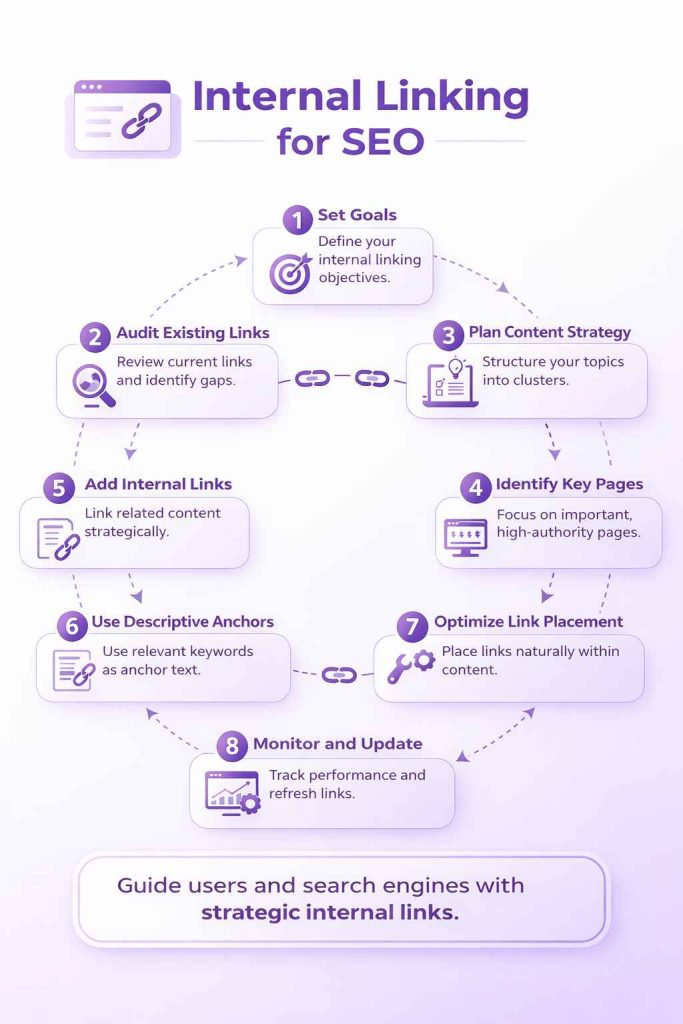
Internal linking for SEO matters because:
- It distributes PageRank internally.
- It improves crawl efficiency.
- It strengthens keyword relevance.
- It reduces orphan pages.
- It increases time on site.
According to a Backlinko study, pages that have strong link signals tend to rank higher. While backlinks drive authority externally, an internal linking strategy amplifies that authority internally.
For businesses searching for SEO agencies, this distinction matters. Many agencies chase backlinks but ignore internal link structure. That gap leaves ranking potential untapped. Strategic internal linking best practices unlock hidden growth without increasing acquisition costs.
What Is Topical Authority in SEO & How Internal Linking Builds Authority
Topical authority SEO refers to a website’s recognised expertise within a specific subject area. When your site covers a topic comprehensively and connects related pages logically, search engines view it as authoritative.
Google’s Helpful Content guidelines emphasise expertise and depth. Authority grows when content connects meaningfully.
Internal linking for SEO builds topical authority by:
- Connecting related subtopics
- Reinforcing semantic relationships
- Structuring SEO content clusters
- Elevating pillar pages
For example, a pillar page about “Enterprise SEO” links to supporting articles like “Technical SEO Audits,” “International SEO,” and “Internal Linking Strategy.” Each supporting page links back to the pillar. This bidirectional structure strengthens relevance.
This framework creates a strong website structure. It also signals expertise. Businesses that dominate competitive niches use structured internal linking best practices to reinforce authority signals.
For a step-by-step guide to solving technical issues that affect crawlability and rankings, explore this detailed technical SEO checklist.
Internal Linking Framework: Step-by-Step Strategy
You need a repeatable internal linking strategy that scales with content growth. Use this framework.
Step 1: Recognise Pillar Pages
Select high-intent core topics aligned with revenue goals. These become authority hubs.
Step 2: Establish Supporting Content
Create detailed supporting articles targeting long-tail variations. Group them into SEO content clusters.
Step 3: Map Relationships
Document how each supporting page connects to the pillar and to related pages.
Step 4: Use Descriptive Anchor Text
Use keyword-rich but natural anchors. Avoid over-optimisation. Maintain clarity.
Step 5: Prioritise High-Authority Pages
Link from pages that already earn traffic or backlinks. This improves the distribution of authority.
Step 6: Eliminate Orphan Pages
Audit your site regularly. Ensure every important page receives at least one contextual link.
Step 7: Maintain Logical Hierarchy
Align links with your internal link structure and navigation flow.
This is the best approach and process that strengthens internal linking for SEO while improving usability. It also supports scalability. As your content library grows, your authority compounds.
At 6s Marketers, we design internal linking strategy frameworks aligned with revenue goals. We build SEO content clusters that improve rankings, traffic, and conversions.
If you want your internal link structure to support growth instead of slowing it down, talk to our experts!
Common Internal Linking Mistakes
Many businesses undermine their rankings with poor execution. Avoid these mistakes.
1. Linking Randomly
Random linking weakens topical authority SEO. Every link must support semantic relevance.
2. Ignoring Anchor Text Strategy
Generic anchors like “click here” dilute context. Use descriptive anchors aligned with search intent.
3. Overloading Pages
Too many links reduce clarity. Focus on meaningful connections.
4. Creating Deep Crawl Paths
Important pages should not require multiple clicks. Maintain a strong, good website structure.
5. Forgetting Updates
As content grows, update older pages with new contextual links. Fresh internal linking for SEO keeps authority balanced.
6. Isolating Revenue Pages
Service pages often lack contextual support. Strengthen them with links from the blog and resource content.
Internal linking best practices require consistency and strategy. When executed correctly, they improve rankings, engagement, and authority.
Conclusion
Internal linking for SEO shapes how search engines understand your brand. It strengthens relevance. It distributes authority. It builds topical authority SEO that compounds over time.
Businesses that think of internal linking strategy as a growth lever achieve more commendable results than competitors who depend only on backlinks. Strong SEO content clusters create durable visibility.
At 6s Marketers, we help businesses to build scalable internal link structure frameworks that are aligned with revenue objectives. We combine technical audits, content strategy, and authority building to drive measurable SEO growth.
If you are searching for an SEO agency that prioritises structure, strategy, and results, connect with us now. Your rankings deserve architecture, not guesswork.