

Search is no longer just a list of blue links. It’s a conversation. In 2026, AI-powered answers, agentic tools, and generative search experiences have changed how people discover, research, and buy. According to Search Engine Land’s 2026 SEO predictions, Google AI Overviews now reach 1.5 billion monthly users, and ChatGPT sees 810 million daily users. The debate about whether AI search matters is officially over.
So where does that leave marketers? Confused, cautious, and desperately trying to figure out whether to double down on SEO strategy or pivot entirely to AI-first content. This blog post cuts through the noise. You’ll get a clear, practical breakdown of the AI vs SEO debate, what still works, what’s changing, and exactly what to prioritize to grow your business in 2026.
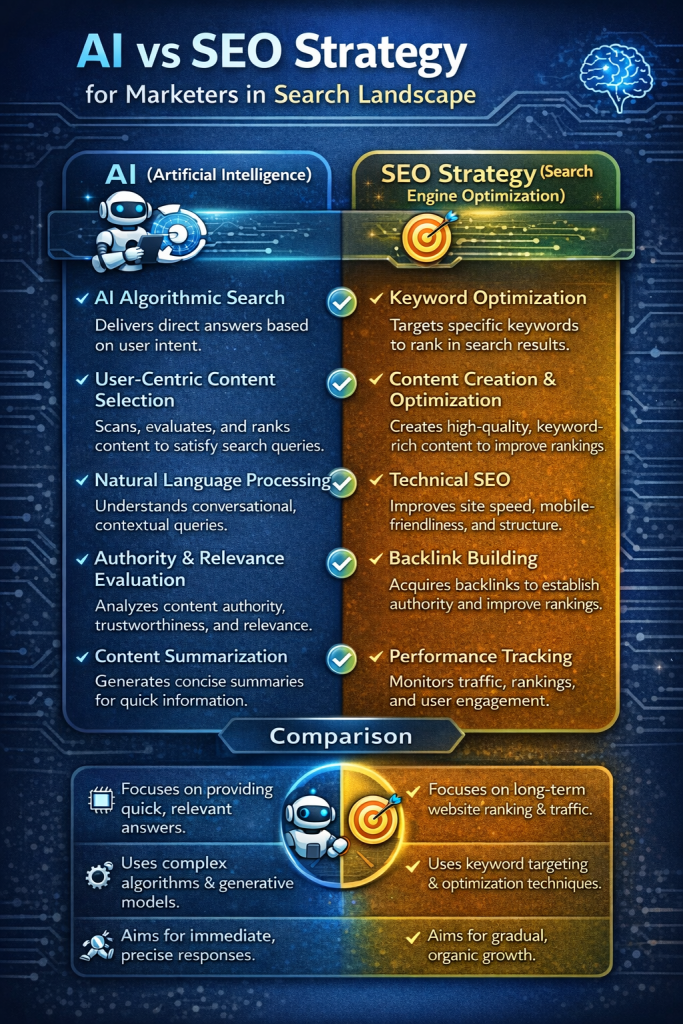
What is AI vs SEO?
Should marketers choose AI or SEO in 2026? Neither replaces the other. AI changes how search works, but SEO fundamentals like authority, relevance, and trust still determine who gets visibility. The smartest marketers use AI as a tool to enhance SEO, not as a substitute for it. In 2026, winning means doing both — and knowing when to prioritize which.
Key Takeaways
Here’s what you’ll learn in this post:
- Why AI search has permanently changed the SEO landscape
- Whether traditional SEO still holds value in 2026
- How AI content compares to human-led strategy
- Exactly what Google rewards in AI-influenced SERPs
- A side-by-side priority comparison of AI tools vs SEO fundamentals
- A clear, actionable plan for marketers navigating both worlds
The Rise of AI in Search
Two years ago, AI search felt like a beta experiment. Today, it’s the default experience for hundreds of millions of users worldwide. Google’s AI Overviews, ChatGPT’s browse mode, and Perplexity’s answer engine have fundamentally shifted user behavior. People now expect direct answers — not pages to click through.
This shift isn’t just technical. It’s behavioral. Users increasingly trust AI-generated summaries over traditional search results, especially for informational queries. Your content needs to be readable, trustworthy, and structured for machines, not just humans.
Learn more about AI search optimization and what it means for your brand.
Furthermore, AI agents are no longer just answering questions. They are beginning to make purchases, compare products, and execute transactions on behalf of users. Brands that haven’t optimized their content for machine readability are already invisible in this new layer of the web.
Is Traditional SEO Still Relevant in 2026?
Short answer: absolutely yes, but it looks different. SEO isn’t dying; it’s splitting into two parallel disciplines. One track focuses on earning human clicks through well-structured, authoritative content. The other focuses on making your brand trustworthy and parseable by AI systems that may never send a user to your website at all.
The mistake most marketers make is treating AI search and traditional SEO as the same strategic problem. They aren’t. Traditional SEO optimizes for clicks. AI search optimization focuses on being cited, trusted, and reused by systems that synthesize information without a click ever happening. Both matter — but they require different tactics. Check out our deep dive on SEO for AI search vs traditional SEO to understand where your efforts should go.
Additionally, on-page fundamentals such as technical health, quality backlinks, E-E-A-T signals, and structured data still directly influence whether AI systems like Google’s AI Overviews choose to feature your content. Ignoring SEO in favor of pure AI tools is a strategic mistake that most businesses can’t afford to make.
AI Content vs Human-Led Strategy: Which Actually Wins?
Here’s where things get nuanced. AI content tools have become remarkably capable. They produce drafts faster, scale output efficiently, and reduce production costs dramatically. Neil Patel of NP Digital noted that teams using intelligent AI workflows have cut content audit time by 75% and reduced costs by 70% through smart model routing. That’s a real competitive edge.
However, the brands winning in AI-influenced search aren’t the ones publishing the most AI-generated content. They’re the ones combining AI efficiency with proprietary human insight. If an AI can easily synthesize your content without crediting you, your content has no defensible value. When you own the data, attribution becomes unavoidable.
So the winning formula isn’t AI content or human content. It is AI-assisted production powered by genuine human experience, original research, and subject-matter expertise. Generative AI in marketing accelerates strategy; it doesn’t replace the thinking behind it.
What Google Actually Rewards in 2026’s Search Landscape
Google’s ranking philosophy hasn’t changed at its core. It still prioritizes helpful, trustworthy, experience-backed content. What has changed is how it surfaces and presents that content. With AI Overviews now dominating the top of the SERP for millions of queries, Google rewards content that answers questions directly, demonstrates genuine expertise, and loads structured signals that its systems can extract and synthesize quickly.
Specifically, Google in 2026 rewards:
- Structured data markup that makes content machine-readable
- Clear content hierarchy with proper heading structure
- Firsthand experience and expertise that AI-generated fluff can’t fake
- Brand entity signals — mentions, citations, and consistent presence across authoritative sources
- Fast, clean technical performance — Core Web Vitals still matter for human users.
- Unique insights and proprietary data that add value beyond what any AI can generate independently
Personalization is also profoundly reshaping rankings. Two people asking the same question in 2026 may receive entirely different answers based on their behavioral history. This makes broad “Position 1” thinking obsolete and demands content strategies built around specific audience segments and intent clusters.
AI vs SEO: Priority Comparison Table
| Factor | AI Tools | SEO Fundamentals | 2026 Priority |
| Content production speed | Very fast | Slower | AI wins |
| Long-term authority building | Limited | Essential | SEO wins |
| AI Overview inclusion | Helps with structure | Requires E-E-A-T | Both required |
| Technical site health | Doesn’t address | Core requirement | SEO wins |
| Proprietary data/insights | Can’t generate | Human-led | SEO + Human wins |
| Agentic search readiness | Machine-readable output | Structured data | Both required |
| Cost efficiency | Significant savings | More resource-intensive | AI helps |
| Trust and credibility signals | AI content often lacks | Built through time | SEO wins |
The takeaway from this table is clear: AI tools and SEO fundamentals are complementary, not competitive. Marketers who treat them as an either/or choice leave serious visibility on the table.
Action Plan for Marketers: What to Do Right Now
Knowing the landscape is one thing. Knowing what to actually do Monday morning is another. Here’s a practical action plan to prioritize in 2026:
1. Audit your content for AI readability. Add structured data markup (Schema.org), use clear heading hierarchies, and ensure your key answers appear in the first 100 words of relevant pages. AI systems pull surface-level answers first.
2. Build your brand entity. Get mentioned consistently on authoritative third-party sites — trade publications, industry blogs, and expert roundups. AI models cite brands they’ve seen referenced across multiple trusted sources.
3. Create proprietary data assets. Commission original research, run customer surveys, and build an index or benchmark study unique to your brand. This creates citation-worthy content that AI tools cannot replicate.
4. Use AI to scale, not to replace. Deploy AI writing tools for drafts, outlines, and repurposing. Then layer in human expertise, real examples, and brand-specific insights before publishing. This hybrid approach beats both pure-AI and purely manual content strategies.
5. Fix your technical SEO foundation. Site speed, mobile optimization, crawl efficiency, and Core Web Vitals remain essential signals. Without a clean technical foundation, even the best content struggles to surface.
6. Track AI citation metrics. Start monitoring whether your brand appears in ChatGPT responses, Google AI Overviews, and Perplexity answers. Tools now exist to track AI search visibility separately from traditional rankings — use them.
7. Train your team. The competitive divide in 2026 isn’t between brands using AI and those that aren’t. It’s between teams that use AI strategically, tied to KPIs, and those that use it for novelty. Invest in proper AI literacy training.
Conclusion
The AI vs SEO debate is a false choice. AI has changed search permanently — but it hasn’t made expertise, authority, and trust irrelevant. If anything, those factors matter more now because AI systems use them as signals to decide who gets cited and who gets ignored.
Marketers who treat AI as a replacement for SEO strategy will lose ground to those who understand that AI amplifies good SEO — and that great SEO creates the conditions for AI visibility. The brands that will lead in 2026 and beyond are those that combine technical SEO rigor with smart AI adoption, proprietary insight, and genuine audience value.
If you’re a business looking to navigate this shift with confidence, 6s Marketers can help. We specialize in forward-thinking SEO services that integrate AI search optimization with proven SEO fundamentals — so you don’t have to choose between the two. From AI search visibility strategy to full-scale technical SEO, our team builds strategies designed for 2026 and beyond.
Connect with 6S Marketers today and let’s build an SEO strategy that keeps you visible — no matter how search evolves.
External Sources:
- Search Engine Land: The Future of Search Visibility — What 6 SEO Leaders Predict for 2026
- Google Blog: Agentic Commerce: AI Tools, Protocol, and Retailers