

For years, marketers running paid campaigns across fintech, ed-tech, real estate, and e-commerce dealt with a stubborn attribution gap. Traffic kept landing in “direct.” Nobody could explain why CAC was drifting. Meanwhile, users were clicking through from ChatGPT responses, Gemini suggestions, and Claude recommendations — and GA4 had no bucket for any of it.
Google closed that gap in May 2026. GA4 now carries a dedicated Google Analytics AI Assistant channel that auto-segments chatbot-referred traffic without any custom setup on your end. For digital businesses actively scaling acquisition, this reshapes what your channel data actually tells you.
Key Takeaways
- GA4 now has a native AI Assistant channel for tracking chatbot traffic.
- Visits from ChatGPT, Gemini, and Claude are auto-tagged — no manual setup needed.
- AI traffic gets its own medium: “ai-assistant” in your channel group reports.
- You can now compare conversion rates across AI vs. organic vs. paid channels.
- GA4’s Task Assistant surfaces tailored property configuration recommendations.
- Generated Insights on the homepage highlights the top data changes since the last login.
- This update directly impacts attribution accuracy for businesses scaling paid acquisition.
What Is the Google Analytics AI Assistant?
The term “Google Analytics AI Assistant” is doing double duty right now, and conflating the two things it refers to leads to the wrong priorities.
One is the new AI traffic channel — GA4’s ability to detect, label, and report on visitors who clicked through from a chatbot like ChatGPT, Gemini, or Claude. The other is GA4’s own internal AI tooling: Generated Insights, which flags top data shifts on your homepage, and Task Assistant, which queues up configuration fixes from the left nav.
Both count as Google Analytics AI features. But the traffic channel is where the immediate commercial value sits for marketing leaders. When a user asks an AI chatbot for a fintech tool recommendation and clicks your link, GA4 now captures that visit properly — rather than silently folding it into direct.
Key Features of the New GA4 AI Assistant Update
1. Automatic AI Traffic Labeling
Before this update, AI-referred sessions had nowhere to go. Depending on whether the chatbot passed a referrer header, visits landed in referral or direct, neither of which told you anything useful. Now GA4 maintains a recognized list of AI assistant domains and assigns sessions accordingly, with no tagging or regex work required on your side.
2. New Traffic Source Dimensions in GA4 AI Reporting
Three new dimension values show up once GA4 identifies an AI-referred session. The medium becomes “ai-assistant,” the channel group reads “AI Assistant,” and the campaign is tagged as “(ai-assistant).” For teams running multi-channel paid campaigns alongside organic, this means cleaner attribution without touching your property configuration.
3. Generated Insights on the Homepage
Added in February 2026, Generated Insights puts a short summary of your top three data changes at the top of the GA4 homepage each time you log in. It covers anomalies, configuration updates, and seasonal shifts — so you catch performance moves without pulling a report or opening Looker Studio.
4. Task Assistant for Property Optimization
Task Assistant, accessible from the left nav, queues up personalized recommendations based on your property’s current configuration gaps. It covers account connections, reporting improvements, and data collection fixes, with the ability to mark tasks complete or skip ones that don’t apply to your current goals.
How the AI Assistant Tracks AI Traffic in GA4
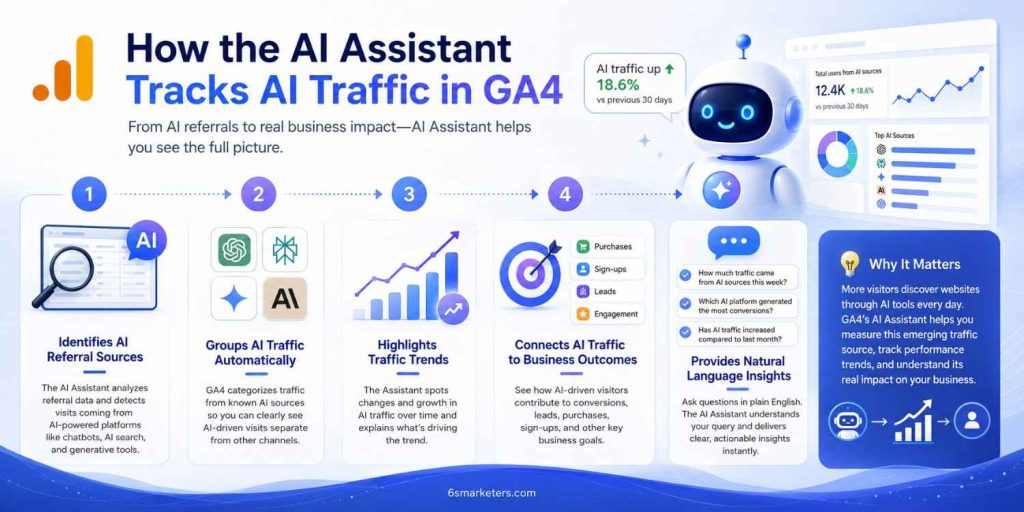
When a user clicks a link inside a chatbot interface, the session referrer originates from the chatbot’s domain: chat.openai.com, gemini.google.com, claude.ai, and so on. GA4 now runs those referrers against a maintained list of recognized AI assistant sources. When there’s a match, the session gets the “ai-assistant” medium automatically. No campaign parameters, no filter setup.
The practical implication for a fintech platform or e-commerce marketplace running aggressive acquisition spend: if a meaningful portion of your “direct” volume was actually AI-referred, your channel-level efficiency numbers have been off. Users arriving from chatbot recommendations often carry higher purchase intent — they’ve already been through a filtering process inside the AI tool. Misattributing that to direct or paid distorts your ROAS math in ways that affect real budget decisions.
Why This Matters for Growth-Focused Digital Businesses
Here’s a scenario that’s more common than most performance teams admit. An ed-tech platform has been running Google Ads and Meta campaigns for six months. CAC is climbing. The team keeps optimizing toward last-click. Nobody flags that a consistent stream of high-intent course signups is coming from users who asked ChatGPT for study platform recommendations and clicked through.
That traffic lands in “direct.” The content team building AI-visible assets gets zero attribution credit. Paid budgets keep growing while the more efficient channel goes unmeasured.
Research published by SparkToro in 2024 suggests that AI tools are becoming part of the search journey, influencing about 20% of searches before users reach a website. In high-consideration categories — financial services, real estate, travel bookings — that share is likely higher. GA4 AI insights now give you the data layer to start measuring this properly.
If you’re running campaigns across India, Singapore, or the US and need cleaner funnel data to defend media spend, talk to the team at 6S Marketers about attribution built for the AI-influenced buyer journey.
Example Use Cases
Fintech & Financial Services: A lending company experiences an unexpected surge in direct visits despite running no new campaigns. Digging into the new AI Assistant channel, they find it traces back to ChatGPT responses on personal finance queries. With the traffic now properly segmented, the growth team builds a content brief specifically targeting the prompts driving those sessions.
Real Estate: A proptech brand notices that Gemini is regularly surfacing their property search tool in NRI buyer queries. That traffic now lives in its own GA4 channel. The product team uses conversion data from those sessions to prioritize features that align with what AI tools highlight.
E-Commerce & Marketplaces: A fashion aggregator pulls AI-referred vs. paid social cohort data for the first time and finds a 35% gap in return rates. GA4 AI reporting makes that comparison possible, and turns “answer engine optimization” from a content team talking point into a real budget conversation.
Potential Limitations & Concerns
The AI assistant in GA4 solves a real problem. A few gaps remain.
Domain coverage has limits. GA4 works from a list of recognized AI assistant sources. A newer or niche chatbot that isn’t on that list will still push its referrals into direct or generic referrals. The list will grow, but it isn’t exhaustive today.
Intent is still invisible. Knowing a user came from ChatGPT is useful. Knowing what they asked the chatbot before clicking your link would be more useful. GA4 doesn’t capture that. Even with advanced tools, uncovering genuine user intent frequently requires direct research and carefully structured prompts.
Volumes are small now. For most properties, AI-referred sessions are a fraction of total traffic. The temptation is to file this away for later. The smarter read is that baseline data captured now will be the benchmark that makes future growth legible — especially as AI-assisted discovery accelerates across mobile and voice interfaces.
Attribution model design is unchanged. An AI-referred user who bounces and returns via paid search three days later still credits paid under last-click. GA4 AI insights improve visibility into traffic sources, but they don’t restructure how credit flows across the conversion path.
Conclusion
The Google Analytics AI assistant update gives marketers something they haven’t had before: a native, no-configuration channel for measuring chatbot-referred traffic inside standard GA4 reports. For businesses in fintech, travel, real estate, ed-tech, and e-commerce — categories where AI-assisted discovery is growing fastest — this fills a real attribution blind spot.
Pull up your Default Channel Group report and check whether the AI Assistant channel is already populating. If your GA4 property is properly configured and live, it should be. From there, the strategic move is treating AI-referred traffic as its own funnel segment — with distinct content, landing page logic, and conversion benchmarks.
Explore GA4 analytics capabilities and when your team is ready to build attribution that accounts for the AI-influenced buyer journey, reach out to 6S Marketers.
Are you already seeing AI-referred sessions in your GA4 reports, or is it still marginal for your vertical? Drop your experience in the comments.