

There’s a fine line between optimizing user journeys and manipulating them. Cross it, and you don’t just lose trust—you risk visibility. That’s exactly where back button hijacking sits today. With Google tightening its stance through the Google spam policy 2026, this once “clever” tactic is now clearly categorized as a deceptive practice.
For businesses relying on organic growth, this is not a minor UX tweak—it’s a ranking risk.
Key Takeaways
- Manipulates browser navigation to trap users
- Violates updated Google spam policies
- Signals a poor user experience to Google
- Impact rankings and crawl trust
- Requires immediate fixes for compliance
- Google is giving site owners 2 months to fix this issue before enforcement starts on June 15, 2026.
What is Back Button Hijacking
Back button hijacking is a form of website navigation manipulation where clicking the browser’s back button doesn’t take users to the previous page. Instead, it redirects them to another page—often ads, pop-ups, or forced landing pages.
This creates a frustrating browser back button issue, where users feel stuck or misled. While it may temporarily increase session time or conversions, it directly conflicts with how the web is meant to function.
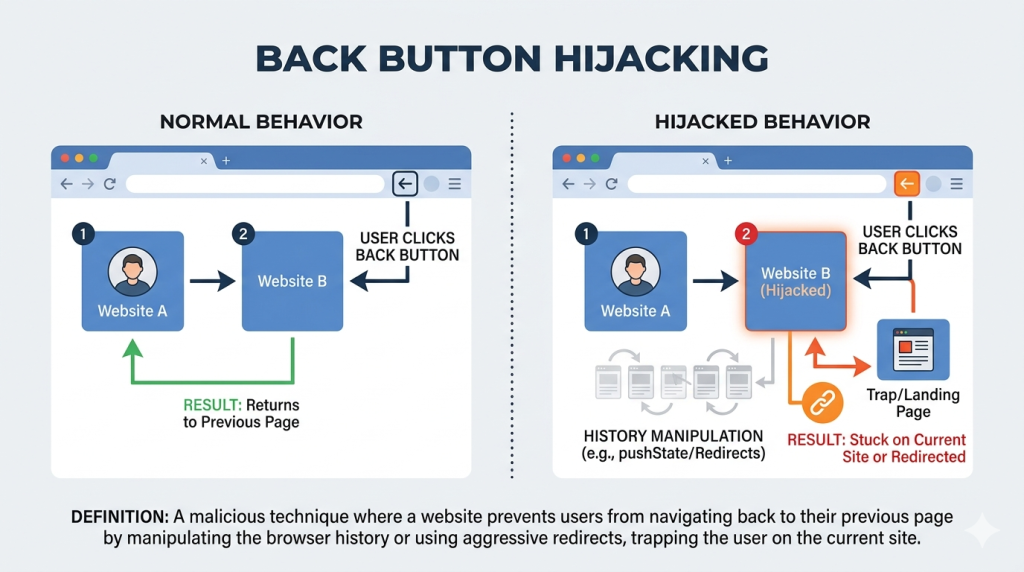
Alt-text: Infographic showing normal back navigation vs back button hijacking loop trapping the user in redirects
Google’s New Spam Policy (2026)
With the Google spam policy 2026, Google has formally classified back button hijacking under deceptive website practices.
This aligns with broader changes seen in the Google March 2026 Spam Update and ongoing refinements in Google Algorithm Updates
Google’s message is simple: if your website interferes with expected browser behavior, it’s not optimization—it’s manipulation. Also note that Google has announced this policy early, giving website owners a 2-month window to make necessary fixes before June 15, 2026, for enforcement.
If you need help with SEO services, connect with us now!
Why Google is Taking Action
Google’s core objective is user trust. When users feel tricked, it damages the entire search ecosystem.
Back button hijacking falls under malicious practices Google is actively targeting because it:
- Breaks standard navigation expectations
- Forces engagement instead of earning it
- Prioritizes short-term gains over user experience
This is also tied to increasing scrutiny on UX issues, Google is no longer separating technical SEO from user experience.
How It Impacts SEO
The impact isn’t subtle.
Websites engaging in back button hijacking may face:
- Ranking drops due to poor UX signals
- Manual actions under the Google Search spam update
- Reduced crawl trust and indexing issues
In competitive industries, even a small trust signal drop can push you off page one.
Examples of Back Button Hijacking
This isn’t always obvious. Some common real-world patterns include:
- Clicking back opens a pop-up instead of exiting
- Users are redirected to unrelated landing pages
- Multiple history entries are injected to trap users
- Affiliate or ad-heavy pages block exit behavior
These tactics often come from outdated growth hacks or aggressive monetization strategies.
How to Fix It
Fixing back button hijacking is straightforward—but requires discipline.
- Remove scripts that override browser behavior
- Audit JavaScript handling of navigation events
- Ensure the back button returns users to the previous page
- Test across browsers and devices
Most importantly, shift focus from forcing engagement to earning it.
Best Practices to Avoid Penalties
If you want to stay compliant and competitive:
- Respect the default browser navigation behavior
- Avoid intrusive interstitials and forced redirects
- Prioritize transparent and user-first journeys
- Regularly audit for deceptive website practices
- Align UX improvements with SEO goals
The best-performing websites don’t trap users. They guide them.
Conclusion
Back button hijacking is a short-term tactic with long-term consequences. Under the Google spam policy 2026, it’s no longer a grey area—it’s a clear violation.
The bigger shift here isn’t just about penalties. It’s about how Google is redefining quality. Technical tricks are losing ground. User trust is becoming the real ranking factor.
If your growth depends on manipulation, it’s fragile. If it’s built on experience, it compounds.