

Expanding into multiple locations looks like you are winning, until your search visibility starts reducing.
They replicate pages, reuse content, and assume “local SEO for multiple locations” is just a scaling problem. It’s not. It is a polarity problem. If your location pages are not specific, search engines will find it difficult to know the differences between them and how valuable each page is. Most importantly, your potential leads will be confused and will find no reason to get engaged.
Using the same content at every location will get your business poor rankings, cannibalization, and missed local opportunities.
If you are serious about establishing a long-term multi location SEO strategy, you need to scale without repeating yourself.
Key Takeaways
- Unique pages drive stronger local rankings
- Duplicate content weakens location relevance
- Google prioritizes localized user intent signals
- GBP optimization boosts visibility per location
- Content depth matters more than page count
- Technical SEO prevents location cannibalization
Introduction to Multi-Location SEO
Local Search Engine Optimization (SEO) for multiple locations is about making sure that each service area, store, or branch is discoverable at its location.
You should understand that Google doesn’t rank companies. It ranks pages that best match local intent.
That means your location pages SEO is more than about listing addresses. It should provide proven relevance at a hyper-local level.
A strong local SEO strategy for multiple locations adheres to three things:
- Local search intent
- Unique content signals
- Accurate business data
You could be one among the businesses that get the third right, but ignore the first two.
If you’re assessing your current approach or planning expansion, it’s worth revisiting your basics. This guide on local SEO strategies for service-based businesses offers a solid baseline before scaling further.
Why Duplicate Content is a Problem
Duplicate content is often misunderstood. It’s not that Google “penalizes” duplication aggressively—it simply filters it out. That’s worse in many cases because your pages don’t get visibility at all.
Here’s what happens when location pages look identical:
- Google can’t distinguish which page to rank
- Pages start competing against each other (keyword cannibalization)
- Crawl budget is wasted on low-value content
More importantly, it sends a signal: your pages aren’t uniquely helpful to the user.
New guidance from search-focused companies is that when launching new locations, companies should not try to reuse content except for the city name.
Google gives preference to pages that actually showcase differences between locations—services, teams, reviews, and local context.
In short, duplication kills differentiation, and differentiation is what drives rankings.
Creating Unique Location Pages
It is at this point that most strategies win or lose. When scaling, every location page should feel like it was built for that particular area only.
What “unique” actually means
It doesn’t mean that you have to rewrite the same content with synonyms. Your content should add new value.
Here’s what high-performing pages include:
1. Location-specific service details
Highlight services that are more relevant or popular in that region.
2. Local team or expertise
Showcase staff, certifications, or experience tied to that branch.
3. Hyper-local proof points
Customer reviews, case studies, or testimonials from that city.
4. Area-specific FAQs
Answer questions that customers in that region actually ask.
5. Embedded maps and directions
Make navigation frictionless.
6. Local partnerships or community presence
Mention nearby landmarks, collaborations, or events.
If you’re unsure how to structure this at scale, it’s worth getting expert input. You can talk to a local SEO expert to map content frameworks that scale without duplication.
Optimizing Google Business Profiles
Your website doesn’t work in isolation. Your Google Business Profile (GBP) is equally critical.
For businesses managing multiple locations, each branch must have its own optimized profile.
Here’s where most teams go wrong:
- Inconsistent NAP (Name, Address, Phone Number)
- Duplicate or unverified listings
- Minimal updates or engagement
A strong GBP setup directly supports your local SEO best practices by improving:
- Map pack visibility
- Local trust signals
- Click-through rates
Each location should have:
- Unique descriptions
- Updated photos
- Regular posts
- Accurate service categories
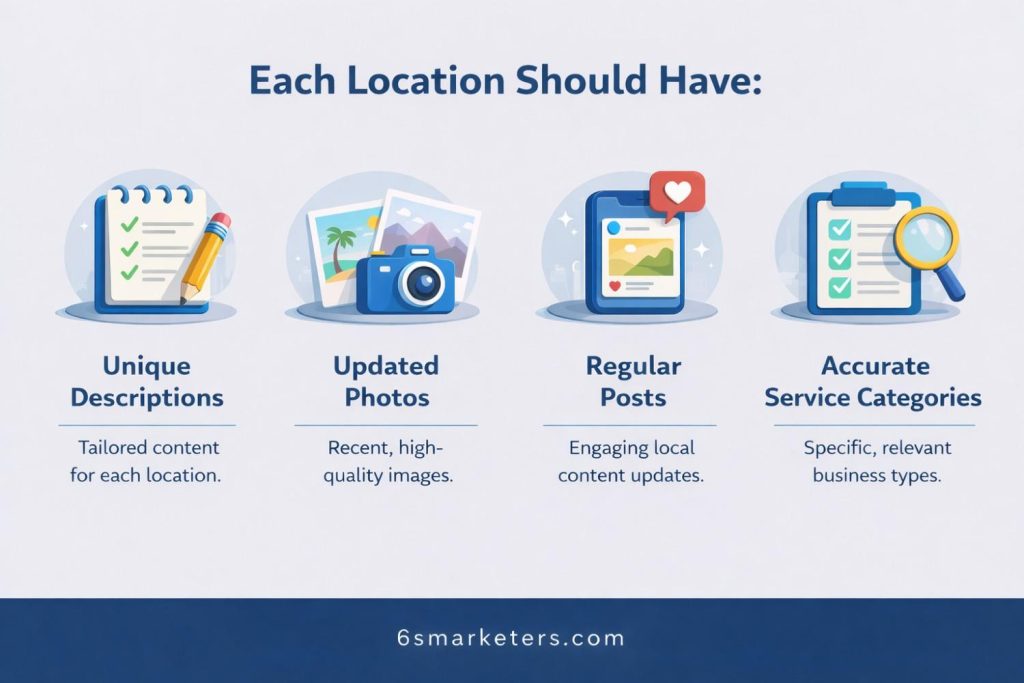
[Alt Txt: Local SEO for Multiple Locations infographic showing unique descriptions, photos, posts, and categories per location]
If you’re auditing your setup, use this Google Business Profile optimization checklist to identify gaps quickly.
Content Strategy for Multiple Locations
Scaling content across locations isn’t about volume—it’s about structure.
A smart multi location SEO strategy uses a layered approach:
1. Core service pages (non-location specific)
These pages target broader keywords and establish authority.
2. Location pages (geo-specific intent)
Each page targets keywords like:
- “service + city”
- “near me” variations
3. Supporting local content
Blogs, guides, or updates tied to specific regions.
For example:
- “How [Service] Works in Bangalore Weather Conditions”
- “Top Challenges Businesses Face in [City]”
This approach avoids duplication while strengthening topical authority.
If your current content feels repetitive or thin, it’s time to rethink the structure—not just rewrite pages. A tailored local SEO services solution can help align content, technical SEO, and local signals into a cohesive strategy.
Technical SEO Considerations
Even the best content can underperform without a proper technical setup.
Here are key elements to get right:
1. URL structure
Keep it clean and scalable:
/locations/city-name/
2. Canonical tags
Prevent duplicate indexing issues across similar pages.
3. Internal linking
Connect location pages with service pages and blogs to distribute authority.
4. Schema markup
Use the LocalBusiness schema for each location to help search engines understand your data.
5. Mobile optimization
Local searches are heavily mobile-driven—slow pages kill conversions.
6. Page speed
Each additional location shouldn’t slow your site down.
Technical SEO is what ensures your location pages’ SEO actually gets discovered and indexed correctly.
Common Mistakes to Avoid in Local SEO Best Practices
Scaling local SEO is tricky—not because it’s complex, but because it’s easy to oversimplify.
Here are mistakes that repeatedly hold businesses back:
1. Copy-paste location pages
Swapping city names isn’t a strategy.
2. Ignoring local intent differences
Each location has unique demand patterns.
3. Inconsistent business information
Even small discrepancies hurt trust signals.
4. Over-reliance on automation
Templates help scale, but they shouldn’t define your content.
5. Neglecting reviews and engagement
Local SEO is as much about reputation as content.
6. Launching pages without authority
New location pages need internal links and supporting content to rank.
Avoiding these mistakes often makes a bigger impact than adding more content.
Conclusion
Measuring your local SEO for multiple locations does not mean that you have to do more. It’s about strategising wisely. When you treat each location as an identical entity, your business will win.
You have to invest in:
- Differentiated content
- Accurate local signals
- Strong technical foundations
And most importantly, you need to align with the strategy on how people actually search—locally, specifically, and with intent.
If you’re planning to expand or already managing multiple locations, this is the moment to fix what doesn’t scale.