

Every growth plan eventually hits the same fork. Pour the budget into the product and let usage carry it into new accounts, or pour it into content and let earned authority pull demand toward you. Framed as product-led vs content-led growth, the argument usually hardens into tribal loyalty, each camp quoting its favorite unicorn. That framing skips the real question. The one worth arguing about is which model compounds, which turns this quarter’s spend into next year’s baseline, and which resets to zero every budget meeting.
Both can compound, and both can flatline into an expensive treadmill. The difference is whether the thing you are building keeps working after you stop pushing it. Here is how the two engines behave in 2026, where each breaks, and which asset is worth compounding in your market.
Key Takeaways
- Compounding needs a self-feeding growth loop
- Product-led growth spreads through product usage
- It stalls when buyers aren’t users
- Content-led growth builds durable authority assets
- AI search rewrote organic growth strategy economics
- The strongest programs run both loops
- Match the model to your market
Product-led and content-led growth both promise the same prize: growth that keeps building on itself. They reach it through different machinery. Product-led growth uses the product as its own salesperson, spreading through invites, shared files, and usage that pulls in the next user. Content-led growth builds a library of trusted material that earns rankings, links, and the 2026 wrinkle citations inside AI answers. This piece breaks down what makes each one compound, where each stalls, and how AI search shifted the math for both, plus a side-by-side comparison and a straight answer on which model fits your stage, buyer, and market.
What “Compounding” Actually Means for a Growth Model
A growth model compounds when every unit of effort raises the floor for the next, so last month’s work makes this month’s cheaper and the baseline keeps climbing through quiet stretches. In growth marketing, that property separates an asset from an expense.
Most programs never get there. They run as a treadmill: results appear while the spend runs and stop when it stops. Paid acquisition is the cleanest example: cut the budget and the pipeline goes dark.
A compounding engine has a loop feeding it, so each customer, page, or product action sets up the next without fresh cash. That loop is the whole contest, and it is the real fork behind product-led vs content-led growth; each model is a different loop you are betting you can build.
Product-Led Growth: What Makes It Compound (and When It Stalls)
Product-led growth makes the product the primary engine of acquisition, retention, and expansion. People adopt it, get value, and pull others in before a salesperson gets involved. OpenView coined the term around 2016, Wes Bush’s 2019 book pushed it mainstream, and the mechanics have held up.
The compounding comes from a usage loop: someone uses the product in a way that exposes a non-user, that person signs up, and the cycle widens on its own.
Product-Led Growth Examples That Compound
Look at how the loop works in practice. Every Calendly invite drops the product in front of someone who has to interact with it to book time, so scheduling a meeting doubles as a demo. Figma spreads the same way: invite a colleague into a file and collaboration becomes distribution. Notion grew on a free personal tier plus a flood of user-made templates that turned customers into marketers. These product-led growth examples share one trait: getting value from the product and spreading it are the same action.
That is the strong version; the engine stalls in predictable spots. It stalls when the buyer is not the user, a developer falls for a tool over a weekend, but the six-figure rollout runs through procurement, security, and a budget owner who never touched the free tier. It stalls when time-to-value is long: if the “aha” needs a migration and three onboarding calls, self-serve spread dies early. It stalls in complex or regulated purchases no individual can put on a personal card. It also reaches a limit when moving upmarket. Companies like Dropbox, Slack, and Zoom initially grew through self-serve adoption. Still, they later introduced enterprise sales teams because the same approach that attracted individual users wasn’t enough to win over buying committees.
2026 piled on new pressure: cheap AI-assisted development made it faster to clone a polished interface, so a product-only advantage wears down quicker than before. The loop still runs; the moat around it now takes more than features.
Content-Led Growth: What Makes It Compound (and What 2026 Changed)
Content-led growth uses published material articles, guides, tools, data to earn attention and trust that turns into demand over time. It compounds because a strong piece keeps working long after you publish it, collecting rankings, links, and references while you sleep.
The mechanics show up clearly in a few operators. HubSpot built an empire on the inbound content and free education it more or less invented as a category. Ahrefs pairs a deep blog with free tools that hand you a reason to sign up. Zapier published thousands of “connect X to Y” integration pages, each ranking for one tiny search and adding up to a huge compounding surface. A serious SEO content strategy that drives leads works the same way: build assets that keep paying rent.
Then 2026 changed the terrain under the old content playbook.
AI Overviews now sit on roughly 48% of Google queries, past 70% for informational and how-to searches. Ahrefs found that an AI Overview cuts the click-through rate on the top organic result by about 58%. Pew Research put hard numbers on the behavior: people click a traditional link 8% of the time when an AI summary appears, against 15% when it does not. Zero-click searches climbed from roughly 56% to 69% in a single year. For B2B technology topics, where AI Overviews trigger on most queries, the old “rank, click, convert” path has narrowed hard.
AI search reshuffled where content-led growth compounds from. The easy-win rank for a keyword, bank the click lost most of its payoff, while the output that is hard to copy climbed in value. Being the source an AI engine cites, or the brand a buyer types in, is authority that thin content could never earn. A modern revenue-focused SEO strategy now optimizes for citation inside AI answers and branded demand. A quieter upside: traffic that still clicks through an AI summary arrives further along, so fewer visits carry more pipeline. A durable organic growth strategy in 2026 measures itself on influence and revenue.
Product-Led vs Content-Led Growth: The Deciding Dimensions
Choosing between them depends on the shape of your market, and a few dimensions do most of the deciding where the choice turns from philosophy into math.
| Factor | Product-Led Growth | Content-Led Growth |
| Primary engine | The product spreading through usage | Published assets earning trust and demand |
| Time to first value | Fast, self-serve, minutes to an “aha” | Slower to build; assets keep paying out |
| Buyer and user | Best when they are the same person | Best when buyers research before buying |
| Sales complexity | Fits simple, low-friction purchases | Fits considered, higher-trust purchases |
| CAC over time | Falls as viral and expansion loops kick in | Falls as authority lowers cost across channels |
| Main risk in 2026 | Cheaper cloning thins the product moat | AI search absorbs easy informational clicks |
| What you are building | A usage asset | An authority and demand asset |
Read the table as a diagnostic for product-led vs content-led growth. Where the product sells itself, and the user can spread it, the usage asset appreciates. Where the purchase is deliberate and trust-driven, the authority asset appreciates and drags acquisition cost down everywhere.
The Hybrid Model: When It Compounds and When It Doesn’t
The strongest compounding machines run both loops as one system. Content creates demand and filters it to real intent, the product converts and expands that intent, and behavioral data feeds the next round of content with proof and specifics. Each loop makes the other cheaper, compounding stacked on compounding.
It works when the two loops share a scoreboard. The content team and the product team point at the same revenue number, and they design their hand-offs on purpose. Well-aimed bottom-of-funnel content for B2B SaaS is often where they meet a comparison page or use-case guide that catches high-intent demand and drops it into a free trial.
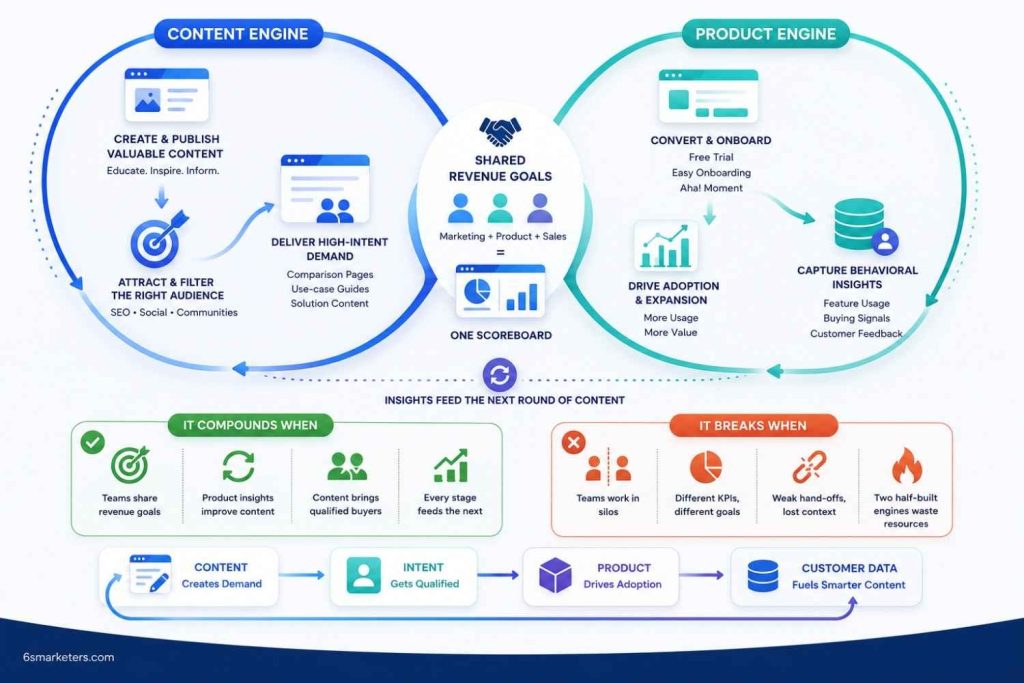
The hybrid approach often breaks down because marketing and sales end up operating with separate budgets and little coordination. One team ships features, another publishes posts, and nobody owns the loop meant to connect them. Two half-built engines burn more than one finished engine returns. For a read on where your loops connect or leak, talk to our team, and we will map it against your funnel.
Which Growth Model Fits Your Stage and Market
For an early-stage brand watching every dollar of runway, content-led growth is usually the cheaper engine to start: a small library of sharp assets costs far less than the product and design investment a credible self-serve motion demands. The trade-off is patience; authority takes quarters to build.
Product-led growth earns its keep when the product delivers obvious value fast, and users can spread it without permission. When users experience value immediately and naturally tell others about it, your product becomes your most cost-effective growth channel. If the purchase is complex and high-trust, content does the heavy lifting and warms the ground ahead of sales.
The honest read on product-led vs content-led growth is that most companies end up sequencing. Lead with the engine that matches your buyer today, prove the loop, then add the second once the first compounds on its own.
Conclusion
The winner of product-led vs content-led growth is never universal. The model that compounds is the one building an appreciating, hard-to-clone asset in your market: a usage asset where the product sells itself on sight, an authority asset where the purchase is deliberate. In 2026, with cloning cheaper and AI search absorbing the easy clicks, the durable edge sits in whatever is hardest to copy: proprietary usage loops, real authority, and a brand people ask for by name. Pick the loop you can realistically build, wire it so each turn lowers the next one’s cost, and resist running both before either works.
So, one worth kicking around: if you switched off paid acquisition tomorrow, which of your loops would keep turning on its own, and which would go quiet by Friday?