

Why Traffic Without Leads Is a Problem
Picture this: it’s Monday morning, and you’re scanning your analytics dashboard. Decent traffic. Respectable time-on-page. A handful of blog posts pulling in organic visitors week after week. On report, it looks like everything is working fine.
But your sales team hasn’t had a warm inbound lead in three weeks. Your contact form is collecting dust. And nobody — not one person who visited your site — actually reached out.
Sound familiar? You’re not alone. This is the quiet crisis that most marketing teams don’t talk about openly: a website that gets traffic but no leads. The numbers feel fine until you realize they’re not moving, the only metric that actually matters — revenue.
Here’s what most businesses get wrong: they treat traffic as the goal. It isn’t. Traffic is the door. Conversion is what happens when someone walks through it. Strong website optimization for lead generation isn’t about getting more people to your site — it’s about making sure the right people take action once they arrive. Without that, every SEO win is just a vanity stat.
Key Takeaways
- Traffic volume doesn’t equal pipeline growth.
- Keyword intent determines visitor quality entirely.
- Buried CTAs cost you conversions daily.
- Speed issues push decision-makers out fast.
- No trust signals? Buyers won’t take chances.
- Vague headlines repel the right prospects.
- SEO without CRO is an incomplete strategy.
High Traffic But Low Conversions — The Real Problems
Let’s get specific. Low conversions rarely come from one catastrophic mistake. More often, it’s a cluster of small, fixable problems that stack up and quietly drain your pipeline. Here are the ten most common ones we see:
- Attracting the wrong kind of searcher: When your SEO strategy targets “what is” and “how does” queries, you rank well — but for people doing homework, not shopping. Real lead generation optimization starts by shifting focus to keywords that signal buying intent: comparisons, pricing pages, vendor shortlists.
- CTAs that don’t earn the click: “Learn More” is not a call to action. Neither is “Submit.” If your CTA doesn’t communicate a clear benefit — what the visitor gets — it’s just a button. Put a compelling, specific CTA above the fold, again mid-page, and once more at the close.
- Pages that load too slowly: According to Google’s research, a page that goes from one second to five seconds to load sees mobile bounce rates jump by 90%. Slow load times don’t just hurt rankings; they destroy first impressions with busy decision-makers who have zero patience for lag.
- Headlines that say nothing specific: “We help companies achieve their goals” — you’ve read it a hundred times, and you’ve moved on just as fast. Generic positioning is a conversion killer. Specificity is trust.
- Missing proof that you actually deliver: Logos, case studies, hard numbers, client testimonials — this is your conversion infrastructure. B2B buyers are cautious. Without credible social proof, your website feels anonymous. Even one detailed case study with real results can dramatically shift conversion rates.
- Contact forms with too many gates: Asking for company size, annual revenue, and phone number before you’ve earned the relationship? First-touch forms should ask for a name and an email — nothing more. Simpler forms consistently increase website conversions without sacrificing lead quality.
- No conversion goal tied to each page: A blog post about SEO best practices attracts a very different reader than a “pricing” page. Treating them identically ignores where each visitor sits in their decision process. Every page should have one clear conversion goal matched to the intent behind that visit.
- Static content that gives visitors nothing to do: Reading is passive. Interacting builds engagement and trust. Calculators, self-assessments, quizzes — these create moments of active participation. Interactive content directly boosts both engagement and conversion rates, and it’s still underused by most B2B websites.
- Ad traffic landing on the wrong page: Message match between your ad copy and your landing page is one of the most overlooked conversion rate optimization tips in B2B marketing, and fixing it is often a quick win.
- SEO and conversion working in separate silos: True search engine optimization designed for lead generation builds conversion intent into the content strategy from the beginning — not as an afterthought.
Increase Website Conversions: Problem vs. Solution
| PROBLEM | SOLUTION |
| Wrong keyword intent | Shift to commercial/transactional terms; audit queries in Search Console monthly |
| Weak CTAs | Rewrite CTAs with a specific benefit; place them above the fold and mid-scroll |
| Slow load speed | Compress assets, enable browser caching, and serve content via a CDN |
| Vague positioning | Rewrite headlines to state a specific outcome for a specific type of client |
| No social proof | Add case studies, client logos, and outcome-driven testimonials to key pages |
| Long, demanding forms | Cut forms to 2-3 fields on first touch; qualify leads progressively |
| No page-level CTA logic | Assign a distinct conversion goal to each page based on visitor intent |
| Passive, static content | Add at least one interactive element — calculator, quiz, or assessment |
| Ad-to-page mismatch | Align the landing page headline language directly with the ad copy that sent traffic |
| SEO and CRO are misaligned | Build conversion goals into content strategy before publishing, not after |
Not sure where visitors are dropping off? We’ll audit your site and pinpoint exactly where conversions are being lost. Get a Conversion Audit.
How to Fix the Website Optimization for Lead Generation Issues
Here’s the thing about conversion problems: they compound quietly. A weak CTA plus a slow page plus generic copy — any one of those alone might cost you 10% of leads. Together, they can wipe out 60% of your potential pipeline. Start here:
Run an intent audit before you redesign anything
Redesigns feel productive. They rarely fix conversions. Before you spend money on a new look, open Google Search Console and pull the actual queries driving your top-traffic pages. Ask: Are these people looking to buy, or are they just learning? If the answer is mostly “learning,” you don’t need a new design — you need new pages targeting commercial-intent keywords. A fresh coat of paint won’t convert the wrong visitor.
Make your value proposition do the work in five seconds
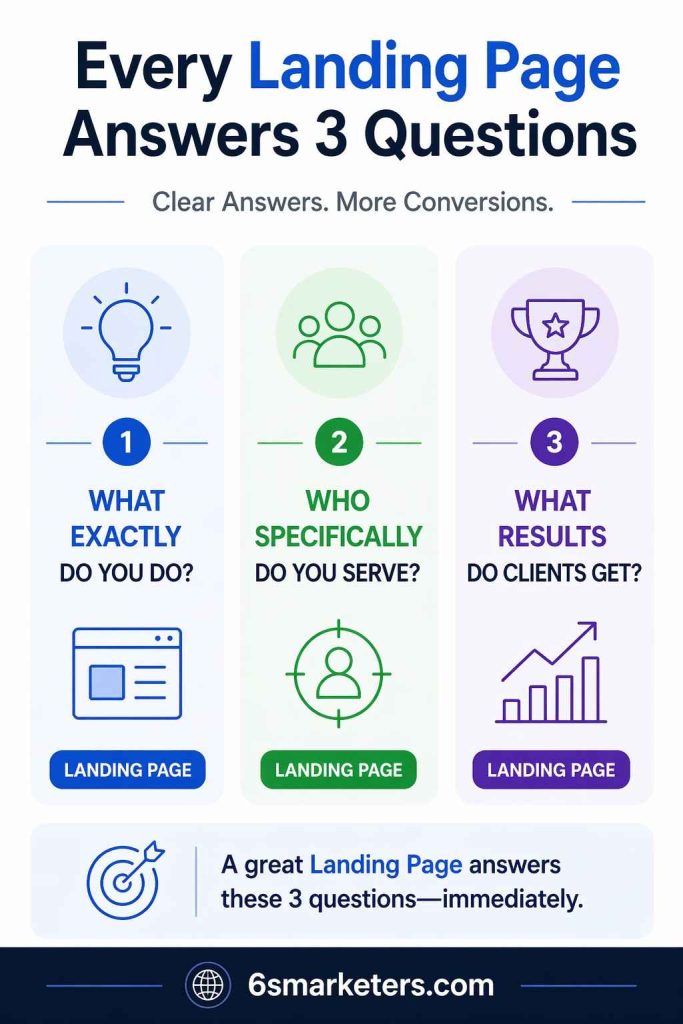
Every landing page you own should answer three questions immediately:
What exactly do you do?
Who specifically do you serve?
What results do clients get?
Pull language from your best client conversations and sales call recordings. The words your clients use to describe their own problems are almost always more powerful than anything written from scratch.
Build distinct conversion paths by traffic source
Someone clicking through from a Google search is not the same as someone arriving from a retargeting ad. They deserve different landing experiences. Dedicated pages with tightly matched messaging for your highest-intent segments are one of the fastest ways to improve website optimization for lead generation without creating new content from scratch.
Let behavioral data show you what to fix
Install a heatmap tool — Hotjar, Microsoft Clarity, or similar. Watch recordings. You’ll quickly see that visitors stop reading before they reach your CTA, or that your form loses people at field three. These aren’t assumptions. They’re observations. Fix what the data reveals.
Treat Core Web Vitals as a revenue issue
Google’s Core Web Vitals are a ranking signal and a conversion signal. A page that loads slowly communicates one thing before a word is read: we are not buttoned up. Run monthly audits via Google PageSpeed Insights. Anything under 80 deserves attention — not because Google said so, but because your best-fit clients are judging you in the first two seconds. This is one of the most underrated conversion rate optimization tips available.
Connect SEO strategy to conversion outcomes from day one
The strongest SEO frameworks built for lead generation don’t treat ranking and converting as separate objectives. Before publishing any page, define what a successful visit looks like: a form fill, a demo request, a content download. Then build the page around making that action easy.
Ready to stop watching qualified visitors leave without converting? Let’s build a strategy that closes the gap. Talk to a Lead Gen Strategist.
Conclusion
There’s a version of “good marketing” that looks impressive in a monthly report but never fills a pipeline. High traffic, low conversions is that version. It’s not a success story with a lag — it’s a structural problem hiding behind healthy-looking numbers.
What makes this fixable — and frustrating — is that none of these issues require a complete overhaul. Sharper CTAs, cleaner messaging, faster pages, better keyword targeting, and a few trust signals in the right places. These are specific, actionable changes that compound over time. Unlike paid campaigns, a conversion improvement on a page works every single day going forward without additional spend.
The businesses getting real traction right now aren’t necessarily generating more traffic than you. They’ve just built websites that treat every visit as a conversation worth having. Every page makes a case. Every CTA earns the click. Every piece of content is built to engage, not just rank.
If your website gets traffic but no leads, stop optimizing for visitors. Start optimizing for decisions.
EXTERNAL REFERENCES
1. Search Engine Land — Driving Traffic But Not Leads? How to Win with SEO and CRO
2. Google Developers — Understanding Core Web Vitals and Their Impact on User Experience