

The AI marketing tools landscape has never been noisier or more consequential. In 2026, marketing leaders face a hard question: which tools are genuinely moving the needle, and which are burning budget on demos that dazzle but don’t deliver?
According to McKinsey’s Global AI Survey, AI content drafting alone delivers a 3.2x application ROI, the highest of any marketing use case (McKinsey, The State of AI). Yet only 41% of marketers can actually prove ROI on their AI investments (Jasper, State of AI in Marketing 2026). That gap between adoption and accountability is where decisions go wrong. This post cuts through the noise and maps nine tools to real, measurable outcomes, so you can build a stack that earns its place in next quarter’s budget review.
Why Most AI Marketing Tools Fail to Deliver ROI
You might agree that most teams don’t fail because they picked the wrong tool. They fail because they picked a tool before defining the problem.
A mid-sized B2B SaaS company, the kind running a 10-person marketing function, managing a $2M annual spend, buys an AI content platform in January. By March, the team had generated hundreds of blog drafts. By June, nobody can tell you whether organic traffic improved, whether leads converted faster, or whether the content actually reflects the brand. The tool worked. The workflow didn’t.
Gartner’s AI Adoption Benchmark Report found that only 27% of enterprises successfully scaled AI marketing initiatives beyond pilot stages, with fragmented data infrastructure (61%), insufficient talent (54%), and absent governance frameworks (48%) as the primary culprits (Gartner Newsroom, 2026). Those aren’t tool problems. There are operational problems.
The other failure pattern is more subtle: teams adopt tools that look great in demos but perform poorly against the actual workflow. Two AI marketing applications consistently underperform in 2026 ROI data: AI video tools (delivering just 1.1x–1.6x ROI because production overhead remains high) and AI-generated paid social creative, which Meta, TikTok, and Google have quietly down-ranked in their 2026 algorithm updates (SQ Magazine, AI in Marketing Statistics 2026).
Knowing what not to buy is half the ROI equation.
Key Takeaways
- AI tools without workflow redesign rarely deliver ROI.
- Only 41% of marketers can prove AI investment returns.
- Content drafting delivers the highest AI ROI at 3.2x.
- AI-driven campaigns show 22% higher ROI and 29% lower acquisition costs.
- Most high-performing teams run 3–5 integrated tools, not one platform.
- Median AI investment payback is now 4.2 months, down from 7.8 in 2024.
- Data unification before tool deployment is the #1 success factor.
How We Evaluated These 9 AI Tools: Our ROI Criteria
Every tool on this list was assessed against four questions:
- Does it reduce a documented cost or time drain? Not a theoretical one.
- Can its impact be tracked against a baseline metric? Conversion rate, content velocity, cost per lead — something concrete.
- Does it integrate with the tools enterprise teams already use? Salesforce, HubSpot, Google Ads, or core CMS platforms.
- Has independent data confirmed the ROI claim? Not just the vendor’s own case studies.
Enterprise teams report 3.4x blended AI ROI, mid-market teams 2.8x, and SMB teams 2.3x — with the enterprise advantage coming mostly from personalization and audience research use cases that scale better against large customer bases (Coupler.io, Marketing ROI Statistics 2026).
The nine tools below reflect that reality. They’re not the flashiest. They’re the ones with the math to back them up.
9 AI Marketing Tools Actually Delivering ROI in 2026
1. HubSpot Breeze AI
HubSpot’s Breeze AI is the clearest example of AI that earns its keep because it lives inside workflows already tied to revenue.
Its Content Assistant handles blog drafts, landing page copy, and email subject lines — all informed by the CRM data underneath. That context matters enormously. When an AI is generating nurture emails while also knowing a lead’s industry, deal stage, and prior engagement history, the output is meaningfully different from a generic prompt.
Per Salesforce’s State of Marketing 2026, AI-driven campaigns deliver roughly 22% higher ROI with 29% lower acquisition costs than traditional ones, and HubSpot Breeze is one of the primary tools enabling that at the mid-market level.
Pricing: Starter from ~$15/seat/month; Professional from ~$890/month.
2. Salesforce Einstein / Agentforce
Salesforce’s Einstein AI layer is what enterprise revenue teams actually use when they talk about “AI marketing.” It handles predictive lead scoring, engagement timing, next-best actions, and now autonomous agent workflows through Agentforce.
The specific ROI driver: Einstein Lead Scoring. Enterprise teams using it consistently report that sales reps focus on the right accounts, not because someone told them to, but because the score says so. Pipeline forecast accuracy improves. Wasted outreach drops.
Enterprise AI marketing tools like Salesforce Einstein should demonstrate positive ROI within 12 months for enterprise implementations, but teams that deploy it without first unifying their CRM data often find it sitting unused for 9–18 months while data infrastructure catches up.
Pricing: Marketing Cloud Engagement starts at $1,250/month; Einstein add-ons typically start at $50–$125/user/month.
3. Jasper AI
Jasper’s core differentiator in 2026 isn’t writing speed. It’s brand voice enforcement at scale. Its Brand Voice 2.0 engine learns tone, style, and messaging from your existing content, then applies it consistently across blog posts, ads, emails, and social copy — regardless of which team member is prompting it.
For an enterprise marketing team managing 15 content contributors, this is genuinely transformative. Brand drift, where your LinkedIn posts sound like they were written by a different company from your website, is a real cost. Jasper solves it.
Research shows human-edited AI content performs 127% better in search rankings than unedited AI output, which is exactly why Jasper’s approval workflow (where AI drafts require human editor sign-off) is part of its enterprise value, not a workaround.
Pricing: Creator from $49/seat/month; Pro from $69/seat/month.
Want help structuring an AI-powered content strategy that integrates with tools like Jasper? Talk to our team at 6S Marketers.
4. Semrush AI Copilot
Semrush has been the industry standard for competitive SEO data for years. In 2026, its AI Copilot feature transforms that data into proactive recommendations — surfacing ranking drops, keyword gaps, and content opportunities without requiring someone to log in and go looking.
The practical use case: a CMO gets a Monday morning briefing on which pages lost rankings over the weekend, what competitors published in the past week, and which keywords the brand is losing to AI Overviews. That used to take an analyst half a day.
Companies using AI for marketing report a 63% efficiency improvement in content production and a 41% lower cost per acquisition in ad optimisation. Semrush contributes directly to both — through smarter content planning and sharper competitive awareness.
For a deeper dive, explore our AI SEO strategy framework built for enterprise content teams.
Pricing: Pro from $139.95/month; Business plans from $449.95/month.
5. Google Performance Max
Performance Max isn’t a third-party tool it’s Google’s AI-native campaign type that allocates budget across Search, Display, YouTube, Gmail, and Discover simultaneously, using machine learning to find conversion opportunities across the entire Google ecosystem.
What makes it a genuine ROI driver: it removes the budget allocation guessing. A B2B software company running a lead generation campaign no longer has to manually decide whether to weight Search or YouTube. Performance Max’s AI models make decisions in real time, based on who is actually converting.
Advertisers using Amazon AI ads achieved 24% higher ROAS compared to generic advertising platforms, with AI-powered placement achieving a 5.4% CTR versus 2.8% with manual placement; a comparable dynamic applies to Google’s AI bidding.
Pricing: Pay-per-click; no platform fee.
6. Surfer SEO
Surfer SEO solves a specific, measurable problem: content teams produce material that doesn’t rank because it’s missing the semantic signals Google’s algorithm expects.
Its Content Editor gives a real-time score as you write, flagging missing topic coverage, keyword gaps, and structural issues against the top-ranking competitors. Its Topical Map feature builds entire content clusters, essential now that Google’s 2025–2026 Helpful Content updates reward topical depth over individual page optimization.
The ROI shows up in organic traffic reclaimed from content that was almost good enough. Many enterprise teams are sitting on 200+ published pages that ranked on page 2. Surfer’s Content Audit identifies which of those are six weeks of editing away from page 1.
Learn how to align your Surfer SEO workflow with getting featured in AI summary results — a growing traffic channel that most teams are still ignoring.
Pricing: Essential from $89/month; Scale from $129/month.
7. Copy.ai Workflows
Copy.ai’s 2026 value isn’t the chat interface; it’s the Workflows product. A single brief can trigger a multi-step sequence: keyword research → article outline → full draft → email nurture sequence → social posts — all maintaining consistent campaign messaging.
For marketing operations teams managing product launches, this matters. Instead of briefing five different contributors across five different tools, one workflow runs the full asset set. QA happens at the end, not throughout.
Pricing: Chat plan from $29/month; Agents plan from $249/month.
8. Seventh Sense
Most email optimization tools help you write better subject lines. Seventh Sense does something more interesting: it analyzes each contact’s individual email engagement history and determines the exact send time most likely to get that person to open.
In a crowded inbox, timing is a genuine competitive edge. A 9 AM batch sent to 50,000 contacts means most of them receive your email when they’re already staring at 40 others. Seventh Sense staggers delivery so each person receives the email when they historically engage. AI hyper-personalised content lifts email CTR from 1.8% to 3.4%, nearly doubling engagement, and send-time optimization is one of the cleaner contributors to that improvement.
Pricing: Available as HubSpot and Marketo integrations; pricing is based on contact volume.
9. Improvado AI Agent
Improvado solves the problem that quietly kills AI marketing ROI: fragmented data. When your Google Ads data lives in one place, your Salesforce pipeline in another, and your HubSpot email data somewhere else entirely, proving marketing’s contribution becomes a full-time job.
Improvado unifies 1,000+ data sources and lets marketing teams query the consolidated data in plain English — no SQL, no analyst bottleneck. Ask “which campaigns generated the most pipeline-qualified leads in Q2?” and get a dashboard.
Organizations new to enterprise analytics platforms typically face a 2–4-week onboarding period, but the compounding benefit — a marketing team that can actually see and prove its ROI is what makes Improvado’s investment defensible at the CFO level.
Pricing: Enterprise pricing; contact for a quote.
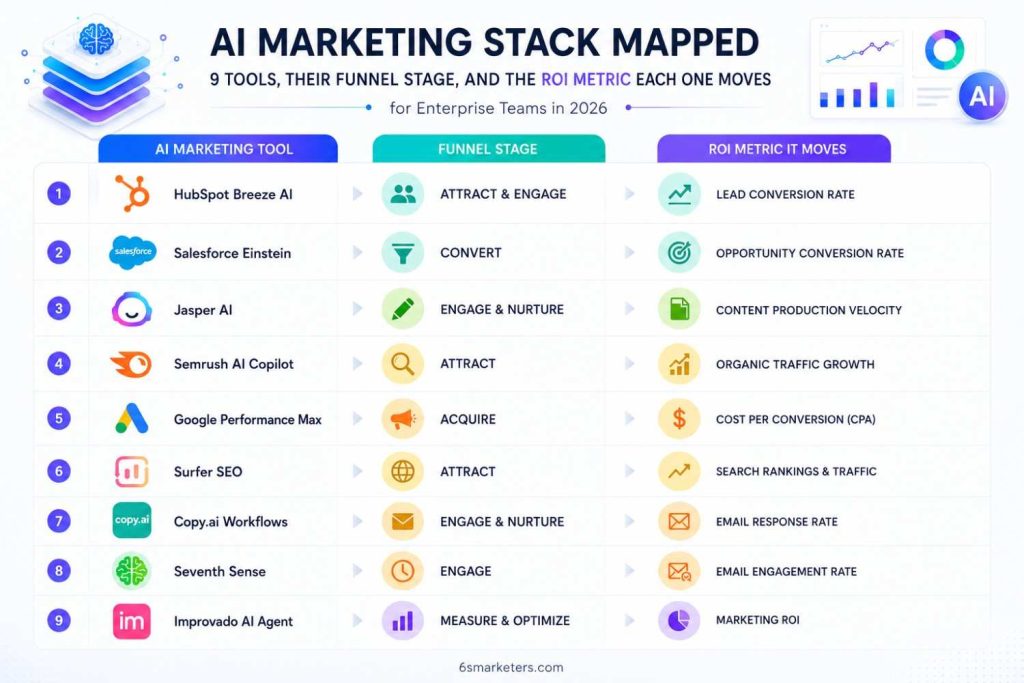
Tool Comparison: Best AI Marketing Tools 2026
| Category | Best Tool | Price (Starting) | Key Strength |
| All-in-One Automation | HubSpot Breeze AI | $15/seat/month | CRM-native AI across full marketing stack |
| Enterprise CRM & Pipeline | Salesforce Einstein | $1,250/month (Marketing Cloud) | Predictive lead scoring at enterprise scale |
| AI Content Marketing | Jasper AI | $49/seat/month | Brand voice consistency at volume |
| SEO Intelligence | Semrush AI Copilot | $139.95/month | Competitive data + proactive AI recommendations |
| Paid Campaign Optimization | Google Performance Max | Pay-per-click | Cross-channel budget allocation via machine learning |
| SEO Content Optimization | Surfer SEO | $89/month | Real-time content scoring and topical authority |
| Campaign Content Production | Copy.ai Workflows | $29/month | Brief-to-full-asset campaign workflows |
| Email Send Optimization | Seventh Sense | Contact-volume pricing | Individual-level send-time personalization |
| Marketing Analytics | Improvado AI Agent | Enterprise pricing | Unified cross-platform data, natural language querying |
How to Build an AI Marketing Stack That Actually Delivers ROI
The teams seeing a 44% increase in marketing output and ROI versus non-AI peers are not the ones with the most tools; they’re the ones using AI across multiple core functions simultaneously.
Here’s the build sequence that works in practice:
Step 1: Unify your data first
An AI tool is only as smart as the data it works with. Before deploying any personalization or predictive scoring tool, your CRM data needs to be clean, and your attribution model needs to be agreed upon internally. This is the step most teams skip, and it’s why their AI investments stall.
Step 2: Pick one platform spine
HubSpot Breeze for mid-market, Salesforce Einstein for enterprise. Build around it. Don’t run two CRMs with AI layers on each.
Step 3: Add specialist tools for your highest-leverage channels
Content at scale? Jasper. Organic search? Surfer + Semrush. Email performance? Seventh Sense. Paid? Performance Max. Each should address a measurable bottleneck, not a hypothetical one.
Step 4: Establish baselines before you deploy
Document your current content production time, cost per lead, organic traffic, and email CTR. Without a baseline, you cannot prove ROI, and without proven ROI, your AI budget disappears in the next planning cycle.
Step 5: Make humans the quality layer, not the execution layer
The best AI marketing tools free your strategists to think while the tools handle production. That only happens if approval workflows are built in from day one.
Ready to build a stack mapped to your specific growth objectives? Our team can help
Conclusion
The AI marketing tools that are delivering real returns in 2026 share one trait: they solve a specific, documented problem in the marketing workflow, and they make that solution measurable. The organizations pulling ahead aren’t the ones with the longest tool list. They’re the ones who identified where the work was breaking down, chose a tool to fix it, built a workflow around it, and tracked the result against a baseline.
Median payback on AI tooling investments is now 4.2 months, down from 7.8 months in 2024. The case for smart, deliberate adoption has never been stronger. The question is no longer whether AI marketing tools work. It’s whether the way you’re deploying them is built to prove it.
The best place to start? Pick your biggest bottleneck. One tool. One measurable outcome. Run it for 90 days. The ROI conversation becomes a lot easier when you have the data to back it up.
What’s the one marketing workflow your team is still doing manually that an AI tool could take off your plate? Drop your answer in the comments — would love to hear what’s on the list.
External Sources
- McKinsey, The State of AI: Application-level ROI data for AI in marketing, including content drafting (3.2x), personalization, and productivity benchmarks.
- Coupler.io, Marketing ROI Statistics 2026: AI marketing ROI data by company size, channel benchmarks, and measurement confidence trends.