

Marketing attribution broke quietly. Universal Analytics retired its Multi-Channel Funnels reports, and the metric teams leaned on to defend upper-funnel spend went with it. GA4 never rebuilt it under the same name. Meanwhile, AI Overviews and AI Mode began answering questions on the results page itself, pushing influence into touchpoints last-click will never record. This article covers what assisted conversions actually measured, why the concept carries more weight now than in 2019, and how to reconstruct that data inside GA4 using a report Google has renamed twice. It also covers the awkward part: what to do when assisted data and your last-click dashboard describe two different quarters.
Two years ago, a client asked us to kill a comparison page. Single-digit key events across six months, against one of the most expensive pages on the site. On paper, an easy cut.
We pulled the attribution paths report first. That page appeared as an early touchpoint on more journeys ending in a demo request than any other page. It never closed a deal on its own. It kept showing up early in the ones that did.
We kept it. Six months on, it still lost every last-click report, and the pipeline it fed had grown.
The gap between what a channel closes and what it contributes runs through this article. The industry calls the missing half assisted conversions, and almost nobody reports on it.
Key Takeaways
- Last-click hides most revenue-driving touchpoints.
- GA4 renamed the assisted conversions report twice.
- AI search creates influence without measurable referrers.
- Early and mid touchpoints reveal assisted conversions.
- Query fan-out breaks keyword-level attribution entirely.
- Bad attribution shrinks budgets, then shrinks pipeline.
Why the Marketing Attribution Model Is Changing Fast
The marketing attribution model most teams still run assumes every meaningful interaction produces a click and a referrer. That assumption expired. Google removed the first click, linear, time decay, and position-based models in November 2023, leaving data-driven and last-click variants. Universal Analytics took Multi-Channel Funnels with it. Generative AI features now resolve a large share of questions before anyone reaches a website.
Three unrelated changes, one consequence: the measurable surface shrank while the influential surface grew.
What Assisted Conversions Actually Measure Inside GA4
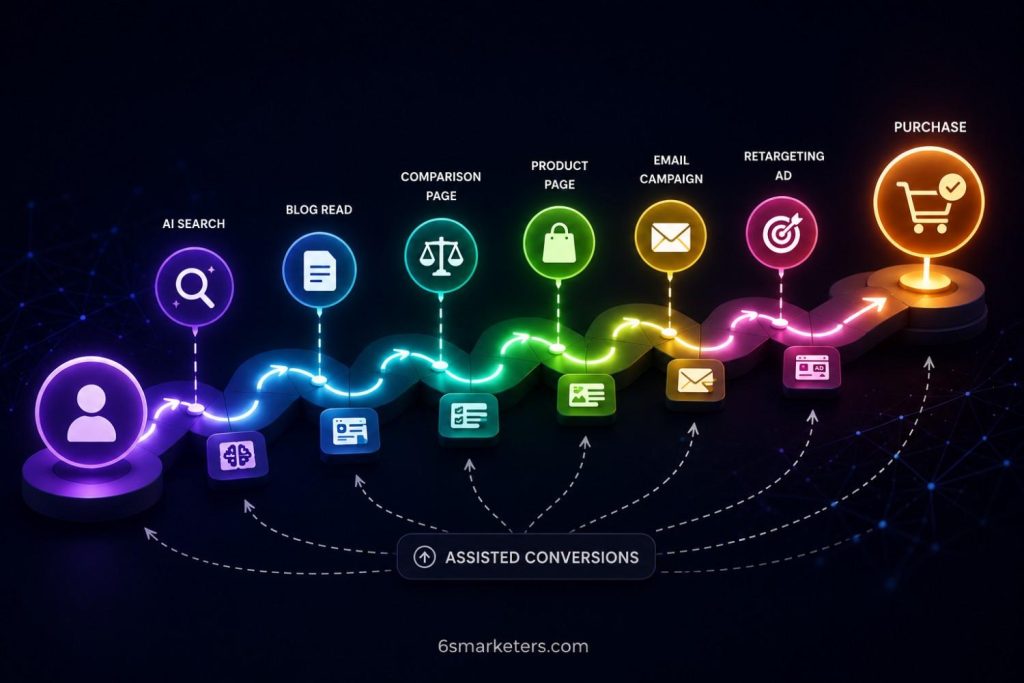
An assisted conversion is any touchpoint on a path that falls before the final interaction preceding a key event. It measures contribution, answering what last-click structurally cannot: which channels started the journey and kept it moving?
Here is the part that trips people up. Universal Analytics reported this as a named metric inside Multi-Channel Funnels. GA4 ships nothing with that label. Google rebuilt the concept as a report and renamed it twice: Conversion paths became Attribution paths, then the Key event attribution paths report. “Conversion” also gave way to “key event” across Analytics.
So when someone tells you GA4 killed assisted conversions, they are half right. The name disappeared. The data survived under a heading almost nobody searches for.
What a Single Assisted Conversion Path Really Looks Like
Take a typical B2B journey: Organic Search → Direct → Paid Search → Email → demo request. Four touchpoints did the work. Email collected the invoice. Multiply that across a quarter and your budget rests on whatever happened last.
Why Last-Click Conversion Attribution Is Losing Ground
Last-click attribution assigns 100% of credit to the final touchpoint before a key event. It stays popular because it is simple and easy to defend in a quarterly review. It also overpays whichever channels sit closest to the transaction.
Google’s documentation makes the mechanism plain: in the Key event attribution paths report, a single-touchpoint path hands all credit to the late segment. Brand search and direct traffic occupy that position constantly. They look like your strongest performers because they are your last performers.
| Dimension | Last-Click Attribution | Assisted Conversions |
| Credits | Final touchpoint only | Every touchpoint on the path |
| Answers | What closed the deal? | What made the deal possible? |
| Typical winners | Brand search, direct, email | Comparison content, video, guides |
| Blind spot | Discovery and consideration | Closing efficiency |
| Best for | Short, low-consideration cycles | Long, multi-session research cycles |
| GA4 location | Default reports | Key event attribution paths report |
| Risk if used alone | Defunds top of funnel | Overstates slow-payback channels |
How AI Search Reshapes the Modern Customer Journey
AI search changes attribution by breaking the link between a question and a click. Google Search Central documents the mechanism as query fan-out: concurrent related queries the model generates to gather more information. Ask how to fix a weed-covered lawn and the system may also run “best herbicides for lawns” behind the scenes. Google can surface your page for a query nobody typed.
Two problems land together. No keyword exists to attribute, because a machine wrote it. And if the reader absorbs the answer without clicking, GA4 records no touchpoint at all. Weeks later they search your brand name and convert, and last-click writes “Organic Search — Brand”.
Google’s documentation confirms the mirror image: Direct is the value Analytics applies when no path data exists to credit a key event. AI-driven discovery frequently parks there. A climbing Direct share with no matching brand campaign is worth investigating, and it ranks among the clearer signs your AI marketing strategy is falling behind.
Why Zero-Click Influence Never Enters Your GA4 Data
GA4 records interactions. AI Overviews produce impressions. An impression that reshapes a buyer’s shortlist leaves no row in any report you own.
Why Assisted Conversions Matter More Than Ever Now
Every measurement gap eventually becomes a budget decision.
When AI features absorb the informational layer of search, the touchpoints surviving to become clicks skew late and transactional. Run last-click on that data and the conclusion writes itself: cut the guides, cut the comparison pages, double down on brand search. Nine months later, brand search volume falls, because nothing upstream creates demand for the brand.
We have watched that loop run at three companies. It never announces itself as an attribution failure. It arrives as a pipeline decline eighteen months after a reasonable-looking reallocation.
Assisted conversions data catches it early. For a second opinion on where your own paths leak credit, talk to our team about an attribution audit.
How to Find Assisted Conversions in Google Analytics
Google Analytics stores this data in the Key event attribution paths report. The route:
- Click Advertising in the left navigation.
- Select Key event attribution paths under the Key events dropdown.
- Choose your key events: demo requests, purchases, qualified form fills.
- Set the dimension to Primary channel group, Source, Medium, or Campaign.
- Read the Early, Mid, and Late touchpoint segments.
Those segments carry the whole idea. Early covers the first 25% of touchpoints on a path, rounded to the nearest whole number. Mid covers the middle 50%, Late the final 25%. Single-touchpoint paths hand everything to Late; paths under three touchpoints leave Mid empty.
Early plus Mid is your assisted view. Any channel with volume there contributes without collecting.
The report also holds data from 14 June 2021 onward and shows paths up to 20 touchpoints, filterable by length. Under data-driven attribution, you will also see fractional credit: decimals in the Key events column summing to 1.0.
What to Do When Assisted Data Contradicts Last-Click
Give each report a job.
Last-click handles short-horizon calls: weekly bid management, promo performance, checkout friction. Assisted data handles annual budget allocation and content investment.
When the two conflict on a channel that matters, check path length distribution first. If most paths carry one touchpoint, last-click is telling the truth about your business. If the median sits at four or more, last-click is describing the final scene of a film it never watched.
Then run a holdout. Pause the disputed channel in one region for a fixed window and watch the total pipeline. Incrementality settles arguments dashboards cannot. Slower, costlier, much harder to argue with.
Building a Multi-Touch Attribution Strategy for AI Search
A workable multi-touch attribution setup for AI search needs five pieces.
- Set data-driven as your reporting model. It spreads fractional credit using your own historical paths.
- Add Search Console’s Generative AI performance report. Google documents it as the way to measure generative AI visibility.
- Enforce UTM discipline on every link you control. Untagged traffic collapses into Direct, and Direct is where assisted conversions go to die.
- Track the assisted-to-last-click ratio quarterly. A ratio drifting upward means the channel is moving earlier in the journey.
- Add one self-reported field to your demo form: “How did you first hear about us?” Free text. It catches zero-click influence GA4 cannot.
That fifth one feels unscientific and consistently beats the other four on long-cycle purchases. Pair it with AEO strategies to get featured in AI answers and disciplined search engine optimization, since generative AI features draw on the same ranking systems as classic Search.
Common Attribution Mistakes That Distort Assisted Data
- Reading attributed data too early. Credit keeps updating for nine days after the event lands.
- Comparing GA4 to Google Ads without aligning settings. The two default to different windows and models.
- Using First user source when Source carries the credit. GA4 carries three source dimensions answering different questions.
- Treating Direct as a channel. Direct is a measurement gap wearing a channel’s uniform.
- Judging content on last-click alone. The expensive one, and it looks responsible until it doesn’t.
Conclusion
The comparison page from the opening is still live. It still loses on last-click every month, and we still renew its budget, because the attribution paths report keeps placing it early in the journeys that end in signed contracts.
Nothing about assisted conversions is new. Universal Analytics handed marketers this metric more than a decade ago. What changed is the cost of ignoring it. When search resolved through ten blue links, upper-funnel content at least earned a click on the way past. AI search removed that consolation prize. Influence now happens in places your analytics cannot see, and the only evidence you get is a pattern buried in path data.
Three things to do this week. Open the Key event attribution paths report and note which channels sit in the Early segment. Add a self-reported attribution question to your primary form. Then pull the assisted-to-last-click ratio for your top five channels and find the one you have quietly been underfunding.
External Sources
- Google Analytics Help: Key events attribution paths report
- Google Search Central: Optimizing your website for generative AI features on Google Search